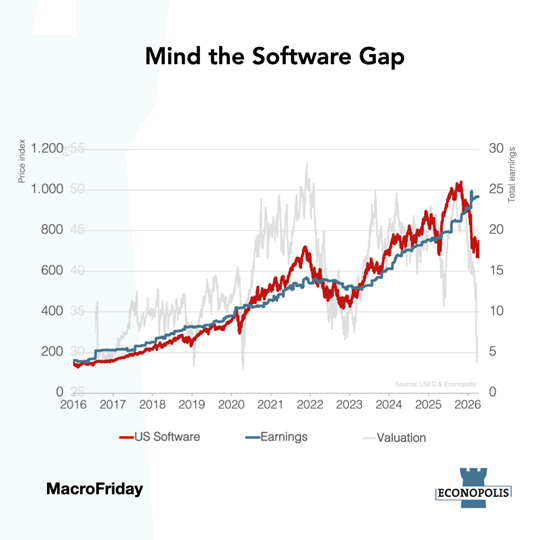
#MacroFriday: Mind The Software Gap
Apart from the situation in the Middle East and uncertainties in private credit, the most important factor in financial markets might be the structural shift that AI is bringing to the economy and companies’ business models, even within the technology sector itself.
Equity prices of software companies have declined sharply (-26% since October), even as earnings of these companies continue to expand. This has resulted in a contraction in valuation multiples, which have fallen from previously elevated levels to decade lows. In the near term, earnings expectations have been revised higher, supported in part by the potential of AI to drive efficiency gains and enhance productivity and profitability within the firms. At the same time, the rapid advancement of AI is raising structural concerns about the durability of traditional software business models, including pricing power and demand for certain applications. This combination of near-term earnings support and longer-term disruption risk has led investors to demand higher risk premia, ultimately resulting in lower valuations despite a still constructive, albeit more uncertain, earnings outlook. The rapid developments in the AI sphere make it more difficult to price earnings further out into the future, a crucial factor for investors’ valuation models.