Senior Technology Advisor
Vibe Coding in a world of Napi’s and Sapi’s
What is Vibe Coding?
According to Wikipedia, the term “vibe coding” emerged in early 2025 and is often attributed to Andrej Karpathy, co-founder of OpenAI and former AI leader at Tesla. It even went on to win the Collins English Dictionary “Word of the Year” for 2025. The idea echoes Karpathy’s famous 2023 quote: “The hottest new programming language is English.”
Vibe coding refers to an AI-assisted software development approach in which developers use natural language prompts to instruct AI models to generate functional software. In practice, it can cover far more than writing code: it includes test scenarios, iteration and refinement, documentation, and increasingly, even workflow design, sometimes without the developer reviewing every line of source code.
The result is speed. Vibe coding turns ideas into working prototypes quickly, and many tools excel at “native AI workflows” such as agentic systems, multi-agent orchestration, and automated task chains.
As Michael Ameling, President of SAP Business Technology Platform, puts it:
“AI-assisted coding marks the start of a new model for software development, where developers shift from coding line by line to shaping the logic, context and goals that guide intelligent systems.”
The hard part: “Enterprise Readiness”
Despite the momentum, vibe coding is not yet a full replacement for traditional software engineering. The main bottleneck is enterprise readiness: the ability to handle real-world complexity at scale, across infrastructure integration, reliability and performance, security and governance, long-term maintainability, and production-grade scalability. In short, vibe coding is powerful, but it still needs to prove itself beyond prototypes and early deployments.
Still, as with every major software transition, the tools alone won’t unlock the full productivity boost. To capture the value, organizations will also need to evolve their engineering culture, processes, and quality standards.
A hot category inside a hot market
Vibe coding tools have quickly become one of the most explosive categories in software. Companies such as Cursor, Lovable, Replit, Windsurf, v0, and Magic have seen a surge in attention, capital inflows, and valuation momentum. Combined valuations across the category reportedly grew more than 350% in a single year, driven by a mix of breathtaking growth and investor excitement.
A striking example: in 2025, Swedish startup Lovable reportedly reached $100 million in annual recurring revenue (ARR) only eight months after launch, placing it among the fastest-scaling software start-ups on record.
Not all tools compete directly. They target different development personas and workflows, with varying degrees of abstraction:
- some optimize for professional developers inside IDE-like environments
- others focus on “prompt-to-app” prototyping for non-technical users
- some integrate deeply into deployment and hosting infrastructure
A key differentiator among vibe coding tools is whose AI model sits underneath the product. Some vendors, such as Lovable, Cursor (Anysphere), and Replit, rely heavily on third-party models, particularly those from Anthropic, while others, including v0 (Vercel) and Magic, have invested more in proprietary training and deeper model customization.
This distinction matters both technically and economically: vendors that depend on external LLM providers like Anthropic, Google, or OpenAI inevitably share part of the revenue pool, because a meaningful slice of the value they deliver is effectively rented rather than owned. At the same time, competitive pressure is intensifying as the model platforms themselves push into the same space, Anthropic with Claude Code, Google with Gemini Code Assist, and OpenAI by integrating Codex into ChatGPT. The central question is whether independent vibe coding tools can sustain durable differentiation, or whether the LLM platforms will ultimately capture most of the value over time.
Napi’s and Sapi’s: A Useful Lens on Who Adopts What
If you zoom out, the history of software development is a story of ever-higher abstraction, moving away from low-level technical detail toward human-friendly ways of describing intent.
- In the 1960s and 1970s, procedural programming abstracted away from assembly language
- Later, object-oriented programming introduced a new model of structure and reuse
- Then came 4GL and low-code tools
- Today, vibe coding raises abstraction again, by using natural language as syntax
This matters because it brings software creation much closer to non-developers: with vibe coding tools, many more people can build prototypes and lightweight applications in days, sometimes even hours. History also suggests that moving to a higher level of abstraction does not reduce the total amount of software work; it typically increases it. When 4GL and low-code tools emerged, demand for development surged, but roles shifted: fewer “classic” programmers did everything end-to-end, more domain experts started building solutions, and specialized work expanded on the infrastructure, security, reliability, and operations side.
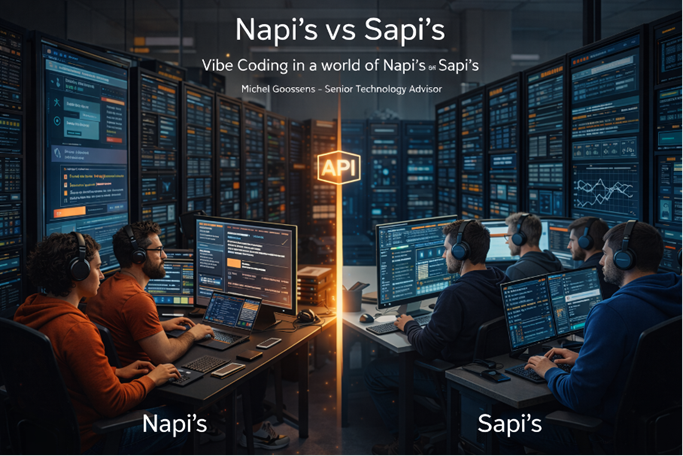
This finally brings us to the Napi’s and Sapi’s, a concept that traces back to the late 1980s, when client-server architecture and 4GLs were the hot topics. The idea is that in any software development organization there are many different types of developers and roles, but we can simplify the picture into two broad groups: Napi’s and Sapi’s.
Napi’s are developers who operate on the north side of the API, while Sapi’s, unsurprisingly, work on the south side of the API. Both groups are highly valuable to an organization, but they focus on different priorities. North of the API is where the end-user experience lives: the user interface, business logic, data flows, and application features. South of the API is about the foundations: infrastructure, databases, scalability, security, and operational reliability.
Because Napi’s are closest to the end user, with constant pressure from deadlines, expectations, and changing requirements, they are naturally drawn to tools that accelerate development and reduce complexity, even if that comes with trade-offs in performance or control. Sapi’s, on the other hand, are responsible for the “enterprise readiness” side of the house and tend to be far more cautious about adopting tools that could introduce performance risks or operational uncertainty. For them, what matters most is control, predictability, and robustness, which makes them less inclined to rely on these toolsets for critical workloads. Today, far more “non-developers” are software-literate than ever before, and in that sense there may never have been as many potential Napi’s as there are now. That helps explain the rocket-fast adoption of vibe coding tools: the total addressable market has suddenly expanded—and the vendors in this space are fully aware of it.
What this means for investors
For investors, vibe coding is not just a developer trend, it is a structural productivity shock in the software value chain. The likely outcome is a much larger software market, where building, testing, and deploying applications becomes cheaper and faster, increasing the number of new products that can be launched. But the economics will not be evenly distributed: the biggest beneficiaries may be the platform owners (cloud providers, model providers, and infrastructure leaders) that capture usage-based revenue at scale, while smaller standalone vibe coding tools risk margin pressure and commoditisation if their differentiation disappears.
In practice, this reinforces the strategic position of Big Tech and AI infrastructure, the companies providing compute, models, developer platforms, and enterprise-grade deployment layers, while pushing the rest of the software industry into a new competitive regime where speed is abundant, but durable advantage becomes harder to defend.
comments powered by Disqus