Kristof graduated as a Master of Business Engineering at the University of Antwerp in 2018 (major in Corporate Finance and Financial engineering). In his master thesis, he examined the profitability of a momentum strategy on various government bond markets. Kristof joined the team of Econopolis as a Business Analyst in September 2018, focusing on data management and the follow-up of the latest wealth management technologies. Since 2020 Kristof, became Senior Consultant within Econopolis Consulting, a strategic advisory services with a focus on climate and energy transition.
Turning scarcity into a competitive advantage, with KPIs as a compass
We are entering an era defined by hard constraints: climate change, finite raw materials, ageing populations, rising defence spending, and the need for large-scale investment in AI. At the same time, Belgium faces high public debt, declining industrial competitiveness, limited physical space and limited access to (critical) raw materials. This combination makes major transitions, most notably the climate transition, feel increasingly daunting, even unrealistic.
However, scarcity is not inherently negative. History shows that structural constraints often act as powerful catalysts for innovation. When solutions are no longer optional but necessary, experimentation accelerates. Once these solutions prove robust and scalable, they can be exported beyond their original context, becoming sources of lasting competitive advantage.
Scarcity-driven innovation: lessons from abroad
Japan is a classic example. Severe space constraints and high land prices made large inventories inefficient. This forced firms to organise production in an extremely lean way. Just-in-Time manufacturing emerged as a practical response to physical scarcity, and was later adopted in other regions in the world.
The Netherlands and Belgium offer another illustration. For centuries, managing water was an existential challenge. The need to control flooding led to deep expertise in water management and dredging. What began as a survival strategy evolved into a globally competitive dredging industry.
These cases show that economic strengths often emerge because of constraints, not despite them. Structural scarcity creates focus, disciplines choices and drives innovation.
Our current bottlenecks
Today, Belgium (and Europe) faces several binding constraints:
- Limited available space in a densely populated region
- Dependence on imported energy and raw materials
- An industrial base under severe competitive pressure
- High and rising public debt, limiting fiscal room
- Time, with a rapidly shrinking carbon budget translated into a very limited room for trial and error
At first glance, this situation appears bleak. Yet these very constraints create a unique environment to develop technologies that thrive under these scarcities. Examples include:
- Agri-PV which combines food and energy production and increase spatial efficiency
- Rooftop solar, avoiding additional land use
- Nuclear energy, with very high spatial efficiency
- Direct electrification, demand-side management, and smart grids that maximise energy efficiency
- Higher material efficiency and circular processes
- Alternative proteins with lower land intensity
Other options, such as large-scale solar parks on land or biofuels competing with food production, are less attractive in space-constrained regions. Scarcity therefore forces prioritization.
Contrast this with regions like Texas, where land and energy are abundant. While this enables large-scale energy production, it also reduces the incentive to develop solutions such as circularity or highly efficient grids. A dense, energy-constrained North-West Europe is a far better testing ground for such innovations.
From bottlenecks to actionable KPIs
The first step in any transition is to define the system’s objective. Assume Europe aims for Net Zero by 2050, combined with a high degree of self-sufficiency. Progress towards this goal is constrained by a small number of real bottlenecks. Identifying them is essential.
In the energy value chain, for example, fully self-sufficient low-carbon electricity cannot be scaled overnight. In the short to medium term, it is constrained by shortages of skilled labour, permitting delays and grid capacity. If clean energy remains scarce over the next decade, priority must go to solutions that deliver the maximum emissions reduction per unit of energy.
If Net Zero by 2050 is to remain credible, policymakers must steer actively on a limited set of core KPIs that reflect the true system constraints. Given the bottlenecks described earlier, climate solutions should be systematically ranked against these bottlenecks. The following table provides an initial overview of key bottlenecks and relevant KPIs for the transition.
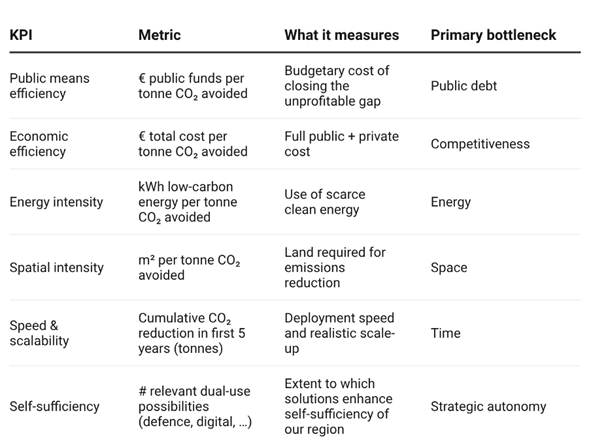
This does not imply a narrowing of climate policy. On the contrary, it is a prerequisite for turning scarcity into direction, focus and ultimately economic opportunity. At the same time, several important nuances must be taken into account: climate solutions should always be assessed from a system-wide perspective, considering entire value chains rather than isolated interventions, and the evaluation should not focus on CO₂ alone, as broader economic, environmental and societal impacts also matter.
Unique constraints create unique comparative advantages. Harvesting these, rather than mimicking other regions, is the path towards reaching our climate ambitions and European self-sufficiency.
At Ortelius, the economic advisory arm of the Econopolis Group, we have conducted extensive research on these themes in recent years. This includes studies on Europe’s supply of critical raw materials and concrete action plans to restore the competitiveness of Flemish industry by 2030.
comments powered by Disqus