Philippe Piessens is Senior Wealth Manager at Econopolis Wealth Management. Philippe has extensive experience in financial services, with a focus on equities. He started his career in 2001 at Lehman Brothers in London, and subsequently worked at HSBC and Kepler Cheuvreux. In addition, Philippe is active in art, as a collector and advisor, and in property, via his family business. Philippe received a BSc in International Relations at the London School of Economics.
Time Is On Your Side
When I find myself in times of trouble, Mother Mary comes to me
Speaking words of wisdom, let it be
And in my hour of darkness she is standing right in front of me
Speaking words of wisdom, let it be
(The Beatles)
Just a few weeks into 2026 uncertainty reigns. Geopolitically the world is moving from one regime to a new yet unknown one. Many countries are experiencing domestic turmoil. And economically, AI’s huge potential is accompanied by great unease on part of employees, businesses and consumers alike. Amidst market volatility and rotation, it is logical that investors feel uncertain, doubtful and even depressed. In this context, it is worthwhile re-examining the benefits of long-term investing, and the pitfalls of focusing too much on short-term headlines.
Timing the market vs time in the market
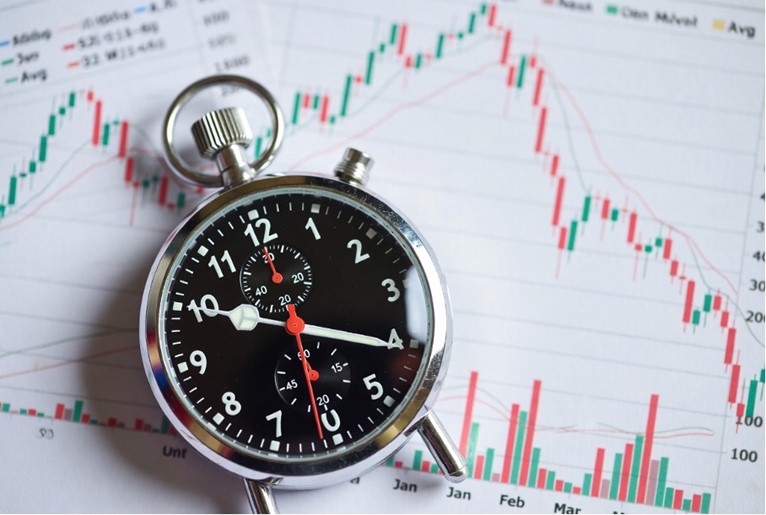
The most important feature of the long-term equity returns mentioned above is that they are not linear or evenly distributed. The shorter an investor’s time horizon, the more they are merely observing the variability of the portfolio, or as Nassim Nicholas Taleb would put it, being “fooled by randomness”. To quantify this, the historical odds of making money in the US stock market are 50/50 over one-day periods, 68% in one-year periods, 88% in 10-year periods, and 100% (so far) in 20-year periods. At the same time, those short-term movements are extremely important in driving portfolio returns. In the 10-year period from 1994 to 2004, your investment return would be half that of the S&P 500 had you missed just the best 10 days of the decade (6.89% instead of 12.07%). If you missed the best 30 days, your return would be negative. In this context, “market-timing”, the attempt to obtain higher-than-average returns by, to put it simplistically, buying low and selling high, achieves precisely the opposite. As the investor Terry Smith has pointed out: “Such approaches to investment are almost all futile. Markets are second order systems. What this means is that in order to successfully implement such market timing strategies you not only have to be able to predict events — interest rate rises, wars, oil price shocks, the impact of the coronavirus, the outcome of elections and referendums — you also need to know what the market was expecting, how it will react and get your timing right. Tricky.” In fact, as studies have shown, over a long-term period, only a single-digit percentage of the most extreme market-timers, the so-called “day traders” have made any money at all. It is as if they all went to Las Vegas, without the fun and free drinks.
Swimming, not sinking
In “The Psychology of Money”, Morgan Housel recounts how in the early years of Berkshire Hathaway, Warren Buffett and Charlie Munger were accompanied by a third partner, Rick Guerin. Unlike his colleagues, Guerin wanted to get rich quickly by using leverage. During the market crash in the 1970s he was “margin-called” and forced to sell his position to Buffett at 40 USD, close to an all-time low. The lesson here is that, even if you are holding a large position in what is arguably the most successful investment company in history, leverage can force you into making catastrophic decisions. Worse, as most investors at one point or other make mistakes, those mistakes get exacerbated by debt. Instead of being able to regroup and learn from their errors, they are wiped out.
Next to debt, investors’ propensity to chase the highest short-term returns is another driver of bad performance, albeit mostly a less lethal one. At any point in time, even during bear markets, specific parts of the market and sub-sectors will be doing well. Seduced by quick riches, investors are prone to pile into these winners at the wrong valuation, only to see short-term gains evaporate and turn into losses when the tide turns and another group of stocks gets in the limelight. In some cases, as when people are piling into the more obscure corners of financial markets, like non-profitable early-stage Technology companies, Crypto companies, Renewable Energy stocks, or small-cap Miners, this can lead to disaster.
Finally, while overactive trading rarely works, neither does inactivity. Attachment to one industry or trend tends to lead to disappointing long-term results, as the world changes, and industries and companies come and go. Investors that, looking back at the carnage of the dot-com crash of 2000, decided to eschew investing in Tech, would have missed out on tremendous returns. Similarly, those that, focused on GDP-growth alone, stubbornly kept the bulk of their portfolio allocation in Emerging Markets, have little to show for it in the past decade.
While investment trends come and go, and not all investment rules work all the time, the key is survival. As it is only by surviving, that one can capture the long-term investment returns mentioned above. To this end, rather than overcomplicating things or trying to emulate the world’s best investors, it is worth keeping in mind a dictum often attributed to Napoleon: “A genius is a man who can do the average thing when all around him are going crazy”.
Tails drive everything
A 2014 study by JP Morgan Asset Management tracking all stocks in the Russell 3000 Index since 1980 showed that 40% of them lost at least 70% of their value and never recovered, and that effectively all the index’s overall returns came from seven stocks. Warren Buffett owned 400 to 500 stocks over his lifetime. He made most of his money in 10 of them, compounding over 20% per annum.
Market commentators often present this phenomenon as a negative – see for example the recent head scratching over the “magnificent seven”, driving all of 2024’s stock market performance. However, there is a silver lining for long-term investors. You can be wrong a lot of the time and still win. To use a basketball analogy, Michael Jordan once said: “I've missed more than 9000 shots in my career. I've lost almost 300 games. 26 times, I've been trusted to take the game winning shot and missed. I've failed over and over and over again in my life. And that is why I succeed.”
Meanwhile, returning to the point raised above, the same pattern plays out when looking at the role of time in an investment portfolio. Just like with individual stocks, a few single days or weeks can make all the difference in long-term performance. How you behaved in the maelstrom of the financial crisis of 2008-09, or during the first Covid lockdown in 2020, may define your lifetime investment returns.
Finally, it is worth pointing out that having an investment portfolio at all is a tail event. While money has been around for millennia, the idea of an investment or retirement account is relatively new. And even today, in an era of plentitude when it comes to investment funds, index trackers, and financial products, the ability to control a substantive investment portfolio tends to be the outcome of a low-odds event, be it professional success, selling a business, or hitting the gene pool lottery.
No free lunch
For rational, patient, long-term investors, great long-term returns are available in equities. That does not mean they come easily. In 170 or so years, stock markets fell by more than 10% over 100 times. They fell by more than 30% over 10 times. Just in the past 25 years, we had a dot-com bubble followed by a crash, 9/11, the demise of Lehman Brothers and the Great Financial Crisis, the Eurozone crisis, Covid-19, the lowest interest rates ever followed by the steepest interest rate increases in history, the invasion of Ukraine, and rolling crises in the Middle East. Stoicism in the face of such turmoil is difficult. Alas, short-term pain and volatility are the price to pay for long-term low double-digit returns. Moreover, those that claim they can offer similar returns “risk-free” are usually lying. In many cases, they are understating the risk, and skimming part of the upside (through fees, or expensive derivative strategies). In some cases, as in Bernie Madoff’s linear 1% per month returns, they are outright crooks. Nothing in life is free. For 90% of the time, stocks are at least 5% off their highs. That uncomfortable feeling that perhaps you should have sold is the price to pay.
Concluding thoughts
While the above has put forward stoicism, risk-management, and taking a long-term time horizon as important principles driving positive investment-returns, how an individual investor implements these can vary. Ahead of his fight with Evander Holyfield, the boxer Mike Tyson famously quipped that “Everyone has a plan until they get punched in the mouth.” In financial markets, no one knows how they will react to a 20-30% drawdown in their portfolio until they experience it. Behind the numbers, investors are human, each with different unique personal circumstances, experiences, and genetic make-up. Someone who experienced the Great Depression will behave differently than someone raised in Silicon Valley in the 1990s.
It is therefore impossible to define universal investment rules beyond those three principles of stoicism, risk-management, and taking a long-term view. For some, it makes sense not to be “fully invested” if it means wearing the inevitable market drawdowns better. While short-term trading is unlikely to produce positive results, doing so with a small part of their portfolio to satisfy a deeper need may make sense for others, if it means they leave the bulk of their portfolio alone. Similarly, investing in stocks of companies whose products they love, or that are geographically close to them may not be rational, but it can help you stay in the market when the going gets tough.
As Finance writer Morgan Housel once said, “Nothing is ever as good or as bad as it seems”. While in financial markets a “goldilocks” scenario rarely lasts long, so do protracted downturns. It is therefore imperative to be “in it to win it”, and to learn along the way.
About the author

Philippe Piessens
comments powered by Disqus