Cédric Van Hooydonk graduated from the University of Antwerp in June 2022 with a Master's degree in Business Engineering. In his final academic year, Cédric joined the Econopolis team as an interim analyst. He combined his internship with a thesis dealing with the dynamic correlation between equity and bond yields. Cédric is a Portfolio Analyst and also a member of the Risk Committee.
Revisiting Boston: Our Boston Dynamics Experience
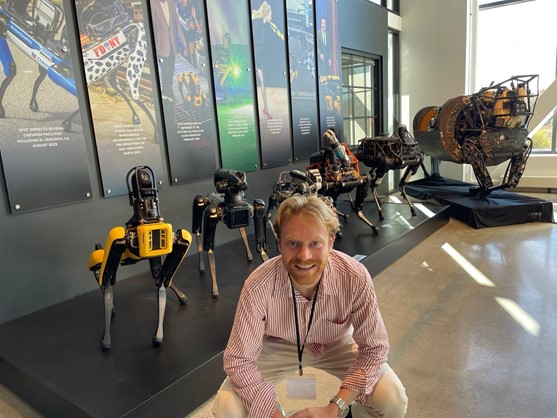
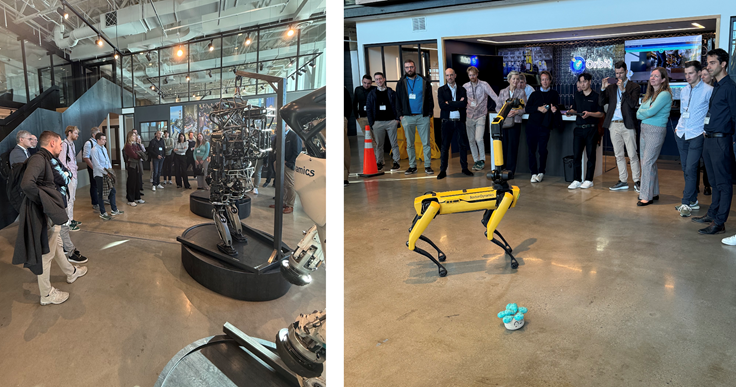
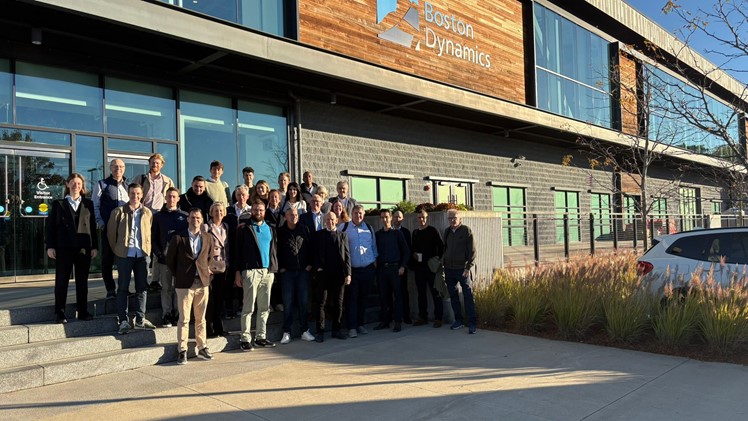
In October last year, the Econopolis team had the chance to visit Boston Dynamics at their headquarters in Boston, Massachusetts. After a fascinating tour through the company’s history, we even got to interact with Spot, their famous dog-like robot built to walk through real-world environments. Naturally, we couldn’t resist asking about their legendary humanoid, Atlas. But when we did, we were politely told a demo wouldn’t be possible because of “ongoing developments.” At the time, that answer felt mysterious. Now, just two months later, we know exactly what those developments were: meet the new Atlas!
Imagine showing up to your job and the new hire doesn’t need coffee breaks. Standing about 2 meters tall and built of metal and circuits, this colleague can heft 50 kg boxes without breaking a sweat. It might sound like a sci-fi gag, but Boston Dynamics just hinted that such a scenario is closer than we think.
Atlas, what happened?
In a splashy live demo on January 5, 2026, Boston Dynamics unveiled a new “production” version of its Atlas robot at the CES tech show in Las Vegas. Unlike the company’s past viral videos of Atlas performing backflips or dance moves, this reveal wasn’t just for YouTube fame, it was on a real stage in front of a live audience. The humanoid walked onstage, waved to the crowd, and showed off its balancing skills.
Why is this a big deal? Because Boston Dynamics isn’t just showing Atlas for fun, they’re putting it to work. The company announced that Atlas is already in production, with every unit they build in 2026 spoken for by two big customers: Hyundai and Google’s DeepMind. (Hyundai Motor Group, which acquired Boston Dynamics in 2021, clearly wants its robots front and center on the factory floor). The message was clear: this isn’t just a tech demo, it’s the start of humanoid robots entering the workforce.
Atlas hitting puberty?
In plain terms, Atlas is no longer just a cool demo; it’s being prepped as an actual product to solve real tasks in industry. This signals a vibe shift in robotics: from “Wow, look what it can do!” (a backflip for example) to “Great, what can it do for us?”
Several factors make this moment feel like a turning point. First, big players and big money are now in the mix. Hyundai is pouring billions into robotics (it even plans to build a factory that can produce 30,000 robots a year) , and it’s gearing up to deploy “tens of thousands” of robots in its manufacturing plants. Google’s AI arm, DeepMind, is teaming up with Boston Dynamics to give Atlas some serious brains. The partnership, announced at CES, will integrate Google DeepMind’s cutting-edge AI models into Atlas , aiming to make the humanoid “act more human around people” and learn new tasks the way people do.
So in short, what changed is Atlas grew up. It’s moving from being an inspiring prototype to an enterprise product with a roadmap. And that points to something bigger: humanoid robots are inching from science fiction toward everyday work life.
Atlas on the job?
The new Atlas isn’t learning ballet or backflips anymore. No, it’s learning to operate in workplaces. Boston Dynamics has refocused Atlas on practical skills: “industrial tasks, from material handling to order fulfillment,” according to the company. Imagine a robot like Atlas loading pallets or fetching parts on an assembly line. That’s exactly the kind of job Boston Dynamics built it for. It’s designed to lift heavy loads, without tiring (except for the battery drainage), and to move with a consistency and precision that could make human supervisors sigh with relief. No more worrying about workers throwing out their backs lifting boxes; Atlas has the strength and never needs to pause to catch its breath.
Crucially, Atlas is built to work alongside people, not in isolation. In traditional industrial robotics, big robotic arms are often kept in cages for safety. Atlas, by contrast, is meant to roam freely in dynamic spaces like a human would. It comes loaded with sensors and software for “human detection and fenceless guarding”. In plain English, Atlas is always watching its surroundings in 360 degrees. If a person gets too close, the robot can slow down or pause. Boston Dynamics even borrows tricks from self-driving car tech: Atlas has an onboard safety system so it knows when forklifts or people are nearby and behaves cautiously. The goal is a robot co-worker that you don’t need to hide behind a cage: one that can, say, pass you a tool or hold a component in place, and not whack you in the process.
What’s it actually like to work next to a humanoid robot? We’ll soon find out at Hyundai’s facilities, where Atlas units are headed first. Atlas is humanoid in form, which is intentional. That shape lets it navigate places built for people (stairs, doorways, etc.) and use tools designed for human hands. In fact, Atlas now has hands designed for real utility, not just stubs. Its new graspers are strong yet surprisingly deft, with “human-scale” fingers that can feel what they’re touching.
For human coworkers, having Atlas on the team could feel like having a super-capable apprentice who never complains. Imagine a scenario: you’re in a warehouse racing to fulfill holiday orders. An Atlas walks up, and it lifts heavy packages onto high shelves that you’d normally need a ladder for, and it does it swiftly and safely. When you’re working a double shift, Atlas is still trooping along diligently, maybe even reminding you to stay clear as it pivots with a heavy load. In an automotive factory, perhaps Atlas holds a car door in place with precision while humans bolt it in, acting like an extra set of ultra-steady hands. The “new coworker vibe” here is a robot that boosts team output and takes on the grunt work, while humans handle the finesse or decision-making parts. One Hyundai executive mused that robots like Atlas could handle tedious parts sequencing tasks by 2028, letting people focus on more skilled work. In other words, Atlas will not steal your job, it might just take over the tasks you don’t miss doing, and in doing so, make your job safer and more interesting.
Atlas, what about us (the humans)?
Before we hand Atlas the keys to the factory, a dose of realism: humanoids still have some growing up to do. Robotics experts caution that despite the rapid progress, we’re not on the verge of replacing human workers en masse with robot doppelgängers, at least not in the next couple of years. Atlas and its peers remain works in progress. They’re impressive, yes, but not infallible. Even Boston Dynamics admits that early Atlas units will have “fairly limited use cases” as they learn the ropes in real workplaces. Think of Atlas’s first assignments as pilot projects: carrying boxes here, fetching tools there, under careful supervision. It’ll be a while before a humanoid can truly do “many different tasks” as fluidly as a person. One robotics analyst noted that dexterity is a major hurdle, today’s humanoids can’t yet handle all the tiny, fiddly actions humans can.
Then there are the soft considerations: jobs, safety, and social acceptance. It’s natural for people to worry, “Will robots like Atlas take jobs away from humans?” So far, the jobs Atlas is aiming for are ones employers often struggle to fill (physically taxing, repetitive labor) or where extra help is welcomed. As one expert put it, humanoids don’t yet have enough dexterity to threaten many human jobs, though that debate will heat up as the robots get more capable. The hope is that Atlas can shoulder the drudgery while humans oversee and do the higher-skill parts of work (a collaboration rather than a replacement). On the safety front, Boston Dynamics and others are proactively developing standards to ensure robots behave safely around people. Regulators and workplace safety boards will no doubt get involved as humanoids move from prototype to production, setting rules for how and where these machines can operate. And let’s not forget governance in terms of behavior: no one wants a rogue 400-pound robot running amok. Fortunately, Atlas is loaded with safety features and is not (despite Hollywood’s fears) an autonomous thinker with its own agenda.
My Closing Thoughts: Walking into the future
The image of Atlas walking confidently across the CES stage might one day be seen as a landmark moment: when humanoid robots left the realm of lab experiments and started walking into our world. It’s a future filled with questions and opportunities. Will we have a “robot co-worker of the month” (I hope not. Better to give that good feeling to a human 😉 )? Will factories roar with the sound of whirring servos alongside human chatter? In my opinion, we should reflect on and steward which tasks we outsource to robots. The dangerous heavy lifting task? Fat yes! But why would we outsource the things we, humans, like to do? I see no point in doing that!
On that note!
About the author

Cédric Van Hooydonk
comments powered by Disqus