Kristof graduated as a Master of Business Engineering at the University of Antwerp in 2018 (major in Corporate Finance and Financial engineering). In his master thesis, he examined the profitability of a momentum strategy on various government bond markets. Kristof joined the team of Econopolis as a Business Analyst in September 2018, focusing on data management and the follow-up of the latest wealth management technologies. Since 2020 Kristof, became Senior Consultant within Econopolis Consulting, a strategic advisory services with a focus on climate and energy transition.
Three maps to show the impact of ETS on European power prices
Last week, we took a closer look at the impact of the Emission Trading System (ETS) – the European system that puts a price on CO₂ emissions – on final electricity prices. We explained how electricity market prices are determined through marginal cost pricing, calculated that ETS accounts for roughly 23% of the marginal production cost of a gas-fired power plant, but noted that the actual impact of ETS on Belgian electricity prices in 2024 was only between 2.8% and 4.3% (for households and non-household consumers, respectively[1]). Gas power plants do not set the market price every hour, and the energy component, the part of the bill affected by ETS, represents at most 50% of the total electricity bill.
This raises the question of how this figure compares with other countries in Europe. Belgium’s electricity generation mix consists of less than 20% gas-fired power, with the rest coming mainly from solar, wind, and nuclear. But what does the impact look like for countries like Poland, where coal and gas plants make up 56% and 12% of the electricity mix, respectively? We illustrate the impact through three maps.
Belgium has a relative clean electricity mix
The first map shows, for each EU country, the amount of emissions per kilowatt-hour of electricity produced. In 2024, Belgium had an average intensity of 145 grams of CO₂ per kilowatt-hour, which is lower than the EU average of 187 gCO₂/kWh. The range across Europe is very wide. Countries like Sweden (nuclear + hydro + wind ≈ 90%), France (nuclear + hydro ≈ 80%), and Portugal (hydro + wind + solar ≈ 80%) show a very low impact, whereas countries in Eastern Europe often have an impact that can be more than ten times higher, such as Estonia and Poland. Germany’s mix is still relatively carbon-intensive as well (coal + gas ≈ 40%). We will see later that this is an important determinant of the ETS’s impact on electricity prices. The higher the fossil – and therefore ETS-covered – share of the mix, the greater the cost is reflected in the electricity bill.
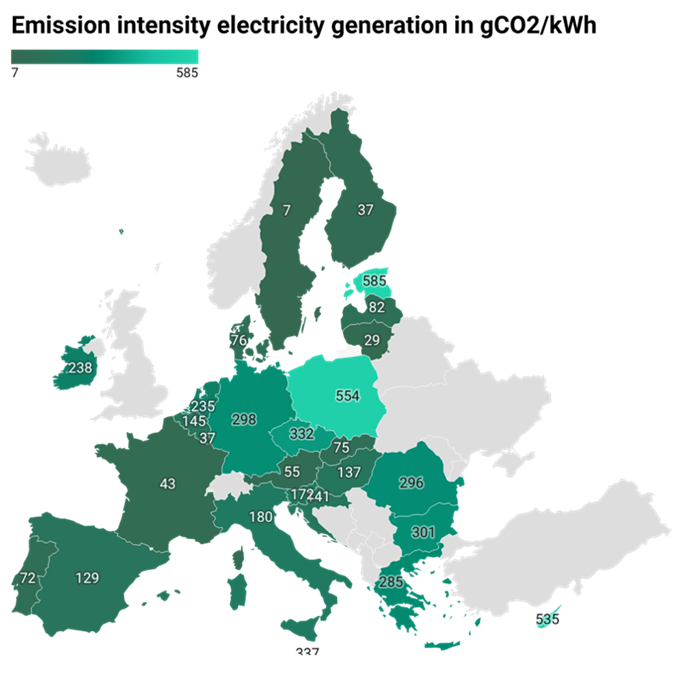
Figure 1: Emission intensity of electricity generation per EU-country in 2024. Source: Data from EEA.
Impact of ETS on final power prices in EU ranges from 0,2% to 21,4%
Using our model, we calculated the impact of CO₂ costs on the final electricity bill for each country based on emission intensities and final electricity prices. This resulted in the following maps:
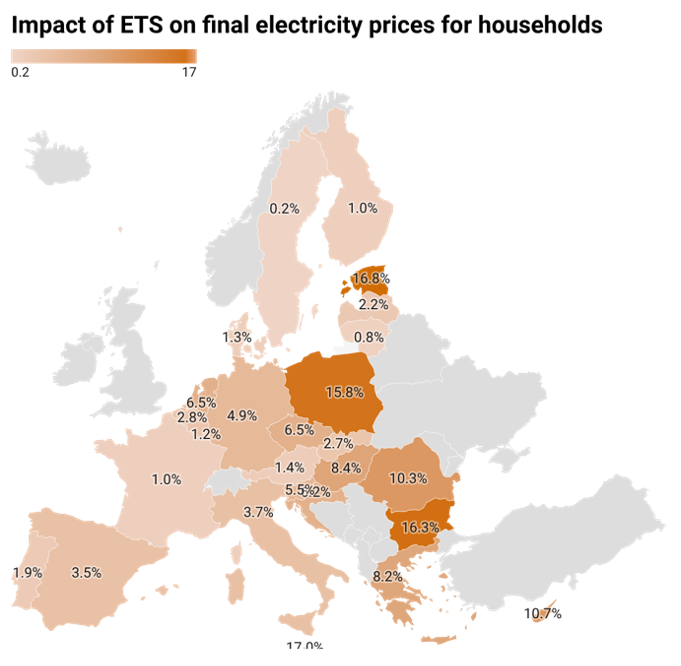
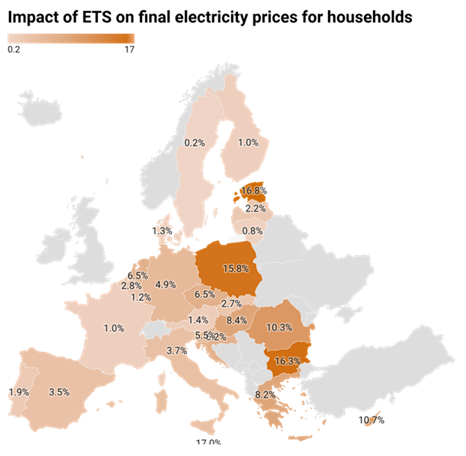
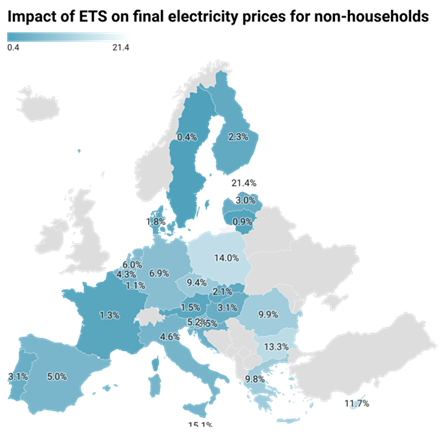
Figure 2: Share of ETS-cost in final electricity price (households vs. non-households) per EU-country in 2024. Source: Ortelius model, data from Eurostat.Non-household consumers relate to the medium standard non-household consumption band with an annual consumption of electricity between 500 MWh and 2.000 MWh. The share of ETS-cost for the energy-intensive industry is expected to be higher.
From this figures, we can draw several conclusions:
- The impact of the ETS on Belgian electricity prices is between 2,8% and 4,3%, which is lower than the EU average of 4,2% to 5,3%.
- There is a strong correlation between the emission intensity of the electricity mix and the ETS impact. Countries with a large share of nuclear, hydro, wind, and solar in their mix typically have low emission intensity, which is reflected in how much the ETS affects their electricity bills.
- The range of ETS impacts is very wide: from 0,2% in Sweden to 17% in Malta.
- Countries with the lowest impact (for households) are Sweden, Lithuania, France, Finland, and Luxembourg.
- Countries with the highest impact (for households) are Cyprus, Poland, Bulgaria, Estonia, and Malta.
Countries whose electricity mix relies heavily on fossil fuels face a double vulnerability: high exposure to fossil fuel prices such as natural gas, as well as high exposure to CO₂ prices. In this sense, the ETS system is a powerful tool to make the phase-out of fossil fuels economically more attractive, and to accelerate the deployment of renewable energy and nuclear power. This will strengthen our economy, accelerate the climate transition, and increase our strategic autonomy.
Underlying assumptions:
[1] We started from the average CO₂ emissions per kWh of electricity produced in Belgium, calculate the associated CO₂ cost, and compare this to the final electricity price for households and businesses. We use an average CO₂ emission intensity of 145 grams of CO₂ per kWh (source: European Environment Agency), a final electricity price for Belgian households of €0.333/kWh and for businesses of €0.218/kWh, and an average ETS cost of €65 per ton in 2024. We did the analysis for household consumers and non-household consumers. Non-household consumers are those with an annual consumption of less than 2,000 MWh. Not all large industrial consumers fall into this category, and they are expected to experience a higher impact from the ETS.
comments powered by Disqus