Kristof graduated as a Master of Business Engineering at the University of Antwerp in 2018 (major in Corporate Finance and Financial engineering). In his master thesis, he examined the profitability of a momentum strategy on various government bond markets. Kristof joined the team of Econopolis as a Business Analyst in September 2018, focusing on data management and the follow-up of the latest wealth management technologies. Since 2020 Kristof, became Senior Consultant within Econopolis Consulting, a strategic advisory services with a focus on climate and energy transition.
Reboot measures for a competitive industry towards 2030
Industrial competitiveness has moved to the top of the European policy agenda. Next week, European leaders will convene at an informal summit in Alden Biesen to discuss how Europe’s industrial base can be safeguarded. Earlier this week, the Flemish Government announced that it will allocate €2 billion over the next ten years to support industry. This is an important step, but it will not be sufficient on its own. In this article, we revisit the root causes of Europe’s industrial challenges and, more importantly, outline Ortelius’ perspective on the solutions needed to restore industrial competitiveness. A reform of the ETS-system, large-scale infrastructure projects and a revival of the nuclear ecosystem as concrete measures towards 2030, and a general shift of focus towards resilience and binational partnerships.
What is driving the competitiveness handicap?
European industry is facing an existential challenge, driven by several structural factors:
- Sharp increases in energy prices
- Intensifying global competition, particularly due to protectionist industrial policies in China and the United States, which structurally disadvantage European firms.
- Rapid technological change, where Europe is increasingly lagging behind the US and China.
- An overly rigid climate policy framework and a persistently negative narrative around economic growth, and industrial activity in particular.
Together, these dynamics are accelerating deindustrialisation across Europe and Belgium, with a real risk of permanently losing strategic value chains, high-quality jobs and long-term investment.
At the European level, however, a policy shift is underway. Industrial competitiveness is once again recognised as a central priority. Initiatives such as the Clean Industrial Deal, the Draghi Report, and the Antwerp Declaration all underline a key message: the climate transition will only succeed if it is underpinned by a strong industrial base, supported by affordable energy, regulatory certainty and targeted public support.
What now matters most is translating these ambitions into concrete action towards 2030. The window for decisive intervention is narrowing rapidly, and industry urgently needs clarity, not only on funding, but also on enabling infrastructure, a coherent energy strategy and a credible response to regulatory complexity.
A vision for a competitive Flemish industry in 2030
In 2025, Ortelius developed a vision for a competitive Flemish industry, in close collaboration with Port of Antwerp-Bruges, North Sea Port, VOKA, BASF and Smart Delta Resources. The objective was to identify a set of concrete policy actions to strengthen industrial competitiveness towards 2030. Figure 1 summarises the five key anchor points of this vision. In the remainder of this article, we explore several of these dimensions in more detail.
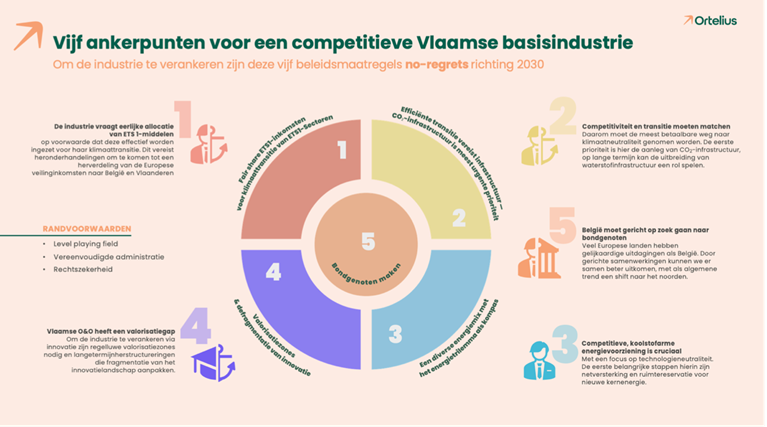
Figure 1: Five anchor points for a competitive Flemish industry. Source: Ortelius analysis - 2025.
Reforming ETS could provide €1 billion for Flanders in 2030
The European Emissions Trading System (ETS) has proven to be an effective tool for reducing CO₂ emissions, delivering a reduction of around 45% since its introduction in 2005. However, the current allocation of auctioning rights, and thus ETS revenues, across Member States is still based on emission shares from 2005, making the system increasingly misaligned with today’s realities.
Belgium entered ETS with a relatively clean electricity mix, largely due to nuclear power, meaning a higher share of its emissions originated from hard-to-abate basic industry. Over time, most emission reductions occurred in the power sector, benefiting countries that relied heavily on coal in 2005. As a result, these countries still receive a disproportionate share of ETS revenues, while countries like Belgium are structurally disadvantaged. In 2024, Belgium accounted for 3,4% of EU ETS emissions, but received only 2,6% of auctioning rights.
This imbalance is even more pronounced at Flemish level: while Flemish industry represented 76% of Belgian ETS emissions, it received just 53% of the auction revenues, which are moreover not fully earmarked for industrial transition. According to Ortelius’ calculations, correcting this mismatch based on a juste retour principle could raise ETS revenues for Flanders to as much as €1 billion by 2030, providing critical funding and breathing space to sustain and strengthen the industrial base during the transition.
System transformations by infrastructure investments
The Flemish Government’s decision to allocate €2 billion, financed through ETS revenues, to support industrial decarbonisation over the next decade is welcome. But this should be seen as a starting point, not the endpoint.
Beyond support for climate-neutral technologies, substantial and rapid investment in enabling infrastructure is essential. Given tight public budgets, prioritisation is key: funds should be directed to infrastructure projects where urgency is highest and system-wide transformation effects are greatest.
At present, two infrastructure priorities clearly stand out:
- Grid reinforcement and interconnections
Growing grid congestion, already acute in the Netherlands and increasingly visible in Flanders, risks becoming a major bottleneck. Strengthening electricity networks is essential to enable industrial electrification, heat pumps, electric mobility, decentralised energy generation and the rapidly rising electricity demand driven by AI and data centres.
- CO₂ Infrastructure
CO₂ infrastructure can unlock rapid and cost-effective emissions reductions. Compared to green hydrogen, carbon capture and storage (CCS) offers abatement costs up to three times lower, while allowing for the retrofitting of existing installations rather than full rebuilds.
Flanders is uniquely well positioned to deploy CCS at scale:
- Large point emitters are located close to one another, significantly reducing infrastructure costs per tonne of CO₂.
- Belgian ports provide access to offshore storage sites, such as depleted gas fields in the North Sea.
- The technology is proven: CCS has been commercially applied since 1972 (initially for enhanced oil recovery), with the first dedicated storage project dating back to 1996.
- Storage capacity is not a limiting factor: the estimated storage potential in the North Sea is 300 to 1.100 times larger than the annual ETS emissions of North Sea countries combined.
Creating energy abundance, not scarcity
If Europe aims to achieve competitive energy self-sufficiency, renewable sources such as offshore wind and solar must be complemented by non-intermittent energy, notably nuclear power. While natural gas will remain part of the energy mix in the short term, relying heavily on US LNG to replace Russian gas is a strategic risk in the current geopolitical context.[1]
Europe should therefore fully embrace small modular reactors (SMRs) and next-generation nuclear technologies, and ensure that spatial planning and permitting do not become structural barriers. Nuclear energy can materially lower overall system costs by reducing the need for large-scale storage, extensive grid reinforcement and flexible backup capacity. The risks of cost overruns and delays can be mitigated by rebuilding Belgian and European nuclear expertise and by achieving scale through a larger and more continuous reactor build-out. The recently constructed EPR reactors in France, the UK, and Finland were all “first-of-a-kind” projects. A study by the U.S. Department of Energy[2] shows that the investment costs of nuclear power decrease by 38% from the first-of-a-kind phase to the second-of-a-kind phase, and by as much as 64% once more than 10 reactors have been built. This is due to learning effects, supply chain development, standardization, and other efficiencies. In other words, it would be an economic missed opportunity to halt the further deployment of EPR reactors in Europe after the most expensive units have been built, leaving all potential technological spillovers untapped.
A clear European nuclear strategy would send a strong and credible signal to industrial investors, while simultaneously encouraging younger generations to pursue studies and careers in nuclear engineering. This is essential to rebuild an ecosystem that has partially eroded over the past decades. Beyond reactor construction alone, such a strategy should also encompass the broader nuclear value chain, including fuel processing, waste management, geological disposal and advanced technologies to reduce the radiotoxicity of nuclear waste. Given the scale, capital intensity and long timelines involved, no single country, certainly not Belgium, can develop this ecosystem alone; at a minimum, coordinated cooperation at Benelux level is required. It would also make sense to spread the risks of the early-stage projects across multiple countries, given that the spillovers in the later scaling-up phase will benefit multiple countries as well.
Resilience and binational cooperation as a new recipe
From now on, we will examine the industrial transition through a different lens: one focused more on resilience and binational collaborations. This represents a break with past approaches.
- Previously, climate policy was primarily framed around a moral narrative, which has proven fragile in a world of power politics and declining multilateralism. A strategy rooted in resilience, by contrast, is likely to drive far more concrete action, precisely because many solutions, such as Small Modular Reactors (SMRs), simultaneously support industrial competitiveness, climate transition, and other strategic objectives.[3]
- Furthermore, in last year’s industrial vision, we advocated for more binational cooperations rather than relying solely on the European level. With key partner countries, such as those in the Benelux, we could jointly launch initiatives around nuclear energy, coordinate energy procurement, or implement a CCS strategy in collaboration with Norway, among other possibilities.
The full industrial vision can be accessed here: Vlaamse Industrievisie 2030.
At Ortelius, the economic advisory arm of the Econopolis Group, we have conducted extensive research on these themes in recent years. This includes studies on Europe’s supply of critical raw materials and concrete action plans to restore the competitiveness of Flemish industry by 2030.
[1] Ortelius-colleague Gillian Neeckx described his take on energy in Europe in a previous Ortelius newsletter: https://www.linkedin.com/pulse/beyond-north-sea-summit-roadmap-affordable-energy-duqve/?trackingId=E0W7HcfXTfSDc1EGHwnX3g%3D%3D
[2] US Department of Energy: Pathways to Commercial Liftoff: Advanced Nuclear (2024)
[3] In recent Ortelius newsletters, this topic was explained detail: https://www.linkedin.com/pulse/why-self-sufficiency-spark-more-climate-action-than-66aje/?trackingId=0%2BSE8LV%2BTCCGz9svAHjASw%3D%3D and https://www.linkedin.com/pulse/climate-shock-from-self-sufficiency-perspective-ortelius-consulting-vbx2e/?trackingId=VDNIVGR4SeKZ2fR0fRExFw%3D%3D
comments powered by Disqus