Siddy holds a Master’s degree in Economics from the University of Antwerp and a Master's degree in Financial Management from the Vlerick Business School. Passionate by innovation and entrepreneurship, he also participated to an Executive Master in Venture Capital at the Berkeley Haas School of Business. Prior to joining Econopolis, he managed the Investor Relations & Treasury office at Orange Belgium, a telecom company. Siddy also held the position of Telecom, Media & Technology analyst at a large Belgian Asset Management firm. Further, he is also active in the advisory board of StartupVillage and The Beacon, a business and innovation hub in the center of Antwerp focused on Internet of Things and Artificial Intelligence in the domains of industry, logistics and smart city. At Econopolis, he is Portfolio Manager of the Econopolis Exponential Technologies Fund.
On CNBC: Looking Beyond the AI Headlines
This week, Siddy Jobe joined Squawk Box Europe on CNBC for a live discussion on the latest results from NVIDIA. What may look like a smooth five-minute television segment is, in reality, an intense exchange. The questions are sharp, the timing is tight, and the audience consists of global investors watching closely.
Together with Stephen Sedgwick, Karen Tso, and Ben Boulos, we explored a simple but crucial question: how should investors interpret Nvidia’s exceptional numbers, and why did the market react so cautiously?
For Econopolis, moments like this matter. They allow us to articulate our long-term investment philosophy in a global arena and demonstrate that our positioning in AI infrastructure is grounded in structural analysis rather than short-term excitement.
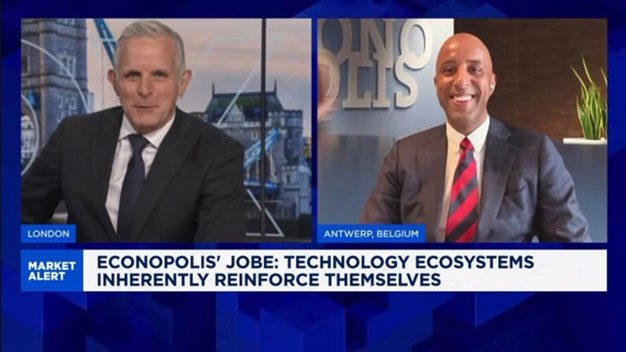
Click below for the full video
Strong Results, Muted Reaction
Nvidia once again exceeded expectations. Quarterly guidance came in roughly $5 billion above sell-side forecasts and around $3 billion above informal buy-side “whisper numbers.” The rollout of the new Blackwell architecture is progressing extremely well, with CEO Jensen Huang describing it as the fastest-selling chip generation in the company’s history.
Yet the stock reaction was subdued. That apparent contradiction says less about Nvidia’s operational performance and more about broader market sentiment. Investors are not questioning today’s demand. They are questioning the sustainability of the massive AI capital expenditure cycle.
From Training to Monetization
To understand where we are in the AI cycle, it is important to distinguish between two phases: training and inference.
During the training phase, companies invest heavily in compute infrastructure to build and refine large AI models. This phase is capital-intensive and cost-heavy. Inference, however, is where monetization begins. Once models are deployed, every query generates “tokens.” Those tokens represent usage, and usage translates into revenue. In other words, training is about building capacity. Inference is about extracting economic value from that capacity.
We are still in the early stages of the inference acceleration. As companies gain clearer visibility into how AI usage translates into measurable revenue and efficiency gains, investor confidence is likely to strengthen.
The CAPEX Debate
A major point raised during the discussion concerned hyperscaler spending. Combined investments in AI infrastructure now amount to hundreds of billions of dollars annually. Some investors worry that this level of capital expenditure may be excessive.
Such concerns are understandable but need perspective. The large cloud players generate substantial free cash flow, maintain strong balance sheets, and operate with multi-year investment horizons. Infrastructure cycles rarely deliver immediate returns. Historically, transformative investments, from railroads to fiber networks, have required patience before fully materializing economically.
What we observe today is a market paradox. On the one hand, investors are pricing in potential long-term disruption in software. On the other hand, they hesitate to price in long-term growth potential in AI infrastructure. That divergence creates opportunities for disciplined, long-term investors.
Is AI a Threat to Software?
Another key topic was the recent sell-off in software stocks. The fear is that AI agents will cannibalize traditional SaaS models.
The reality is more nuanced. Not all software companies are equally exposed. Firms that actively enable AI, by managing data, optimizing performance, or embedding AI into mission-critical workflows, are likely to strengthen their position. Examples include Snowflake and Datadog. Their services are deeply integrated into enterprise systems and difficult to replace.
By contrast, more horizontal productivity tools such as Asana may face greater long-term pressure, particularly where switching costs are relatively low.
Importantly, structural disruption unfolds over years, not quarters. The current market reaction may be front-loading fears that will materialize only gradually, if at all.
What This Means for Investors
The central message from the conversation was straightforward: we are in the midst of a structural technological transformation. Such transitions inevitably bring volatility, skepticism, and periodic corrections. Artificial intelligence is not a passing trend. It is becoming a foundational layer of the global economy.
At Econopolis, we focus on companies that form the infrastructure of that transformation, businesses with durable competitive advantages, strong balance sheets, and exposure to multi-year growth drivers. Not every company will successfully monetize AI. But the overall trajectory of the technology is clear.
Live television demands clarity. In a few minutes, you must distill years of research into a coherent view. Siddy’s conclusion remains unchanged: markets may hesitate in the short term, but the structural direction of AI is unmistakable.
About the author

Siddy Jobe