Bernard Thant graduated as master in Commercial Sciences at EHSAL (now known as Hogeschool-Universiteit Brussel). Afterwards he completed a one-year postgraduate in Finance and Investment Management. After his studies he joined Société Générale Private Banking Belgium (previously Bank De Maertelaere) where he worked for most of his career as a financial analyst. During that time, he also acted as portfolio manager equities at the same company for a number of years. Bernard joined the Econopolis Wealth Management team in September 2014 as an equity analyst.
Offshore wind energy: renewed European ambition
Wind energy is affordable – it has a low levelised cost of energy compared to other energy sources –, is sustainable (renewable, helps to mitigate climate change), reduces countries’ dependence on imported energy (energy security) and enhances the energy system resilience. Over the past two decades, global wind capacity (offshore and onshore combined) grew over twenty-fold and now represents some 8% of total electricity generation according to the Global Wind Energy Council. The total installed capacity of wind power stood at 1 TW in 2023. This figure is expected to at least double by the end of 2030. However, a tripling of capacity is needed in order to achieve the 1.5°C pathway.
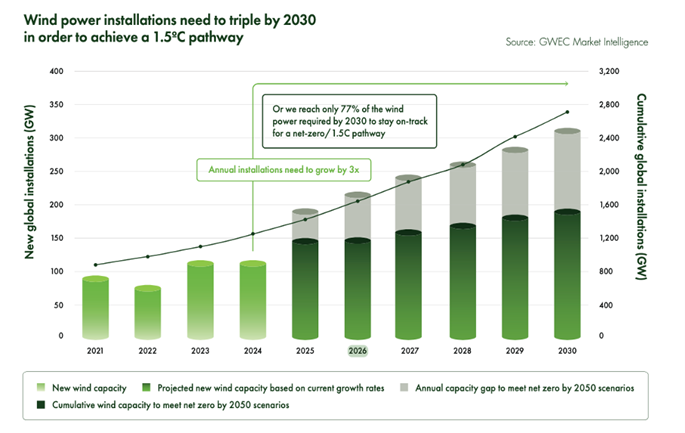 Source: GWEC Market Intelligence
Asia-Pacific is the most important region for wind energy, representing 75% of global market share in 2024. By 2030, half of the installed wind power capacity will be in Asia-Pacific. Unsurprisingly, in wind turbines, China dominates the top 4 spots in the world. Of the 127 GW of new wind power installed in 2024, Goldwind had a market share of some 16.2%, Envision 13.5%, Mingyang 9.7% and Windey 9.1% according to the Global Wind Energy Council. Vestas Wind Systems (Vestas) is the number 5 in the industry with a global market share of 8.7%, but is the largest player ex-China. Siemens Gamesa has a market share of some 5.3% and Nordex has a 5.0% market share. US company GE Vernova holds a 4.1% market share.
Unlike the US, where offshore wind energy sector faces strong political opposition, Europe is fully committed to offshore wind energy. At the North Sea Summit in Hamburg in early February, 9 European countries (Belgium, Denmark, France, Germany, Ireland, Luxembourg, the Netherlands, Norway and the UK) gathered with the wind industry and Transmission System Operators (TSO’s) of the electricity and hydrogen networks. The goal of the meeting was to advance Europe’s energy security, competitiveness, and decarbonisation ambitions via boosting offshore wind power.
Today 37 GW (that is more than 6,000 turbines) of offshore windpower is installed in 13 countries across Europe. The newly announced plan, called the ‘Joint Offshore Wind Investment Pact for the North Sea’, foresees EUR 1,000 bn of investments to reach 300 GW of offshore wind capacity in the North Seas by the midst of the century. One third of this volume will be realised through cross border projects.
In exchange for investment and planning certainty by governments (commitment to build 15 GW of offshore wind per year over 2031-2040 and through the promise of new auctions for offshore wind farms), the industry promises to reduce costs by 30% by 2040. Cost savings will stem from economies of scale, lower financing costs and continued industrialisation. The industry also promises to invest €9.5 billion in supply chain capacities by 2030. The latter include manufacturing capacity, port infrastructure and vessels.
In addition to support national offshore wind farms, Transmission System Operators (TSOs) are focusing on identifying high-value collaborative projects across the North Seas. The goal is to pinpoint 20 GW of viable cross-border initiatives by 2027 for rollout in the 2030s. These ventures include hybrid offshore systems that integrate power generation with interconnection, alongside single-country projects linked to foreign grids. Furthermore, the TSOs will establish frameworks for sharing the costs of these joint efforts.
The ‘Investment Pact for the North Sea’, foresees in the creation of 91,000 new jobs by 2031, leading to total employment of 187,000 people in the industry. Of this figure, some 75% will serve the North Seas Region.
While the US is doing everything to block Offshore energy on its territories, Europe is doubling down on Offshore wind energy. Time will tell what the smartest strategy is, but for sure the European decision will help to lower the cost of energy in Europe and increase Europe’s energy independence.
https://www.pexels.com/photo/wind-turbines-on-the-sea-13223602/
Source: Pexels, Damir K.
About the author

Bernard Thant
comments powered by Disqus