#MacroFriday: The EU's Art of the Deal
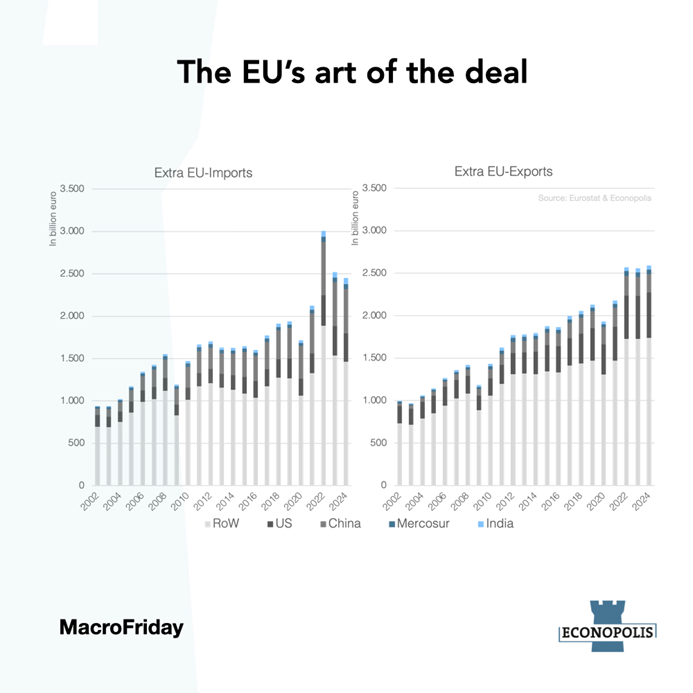
The EU’s trade commissioners had a busy start to the year as the Union closed deals with India and the Mercosur countries. This reflects the European strategy of diversifying trade flows in a changing global landscape.
European Commission President Ursula von der Leyen described the trade deal with India as the “mother of all deals”. The agreement eliminates or reduces trade tariffs on over 96.6% of EU goods exports to India and on 99.5% of imports of Indian goods. It represents the world’s largest free trade zone, encompassing 2 billion people and 25% of global GDP. EU goods exports to India stood at €49 billion in 2024, while goods imports from India amounted to €71 billion and primarily consisted of machinery, chemicals and fuels, and transport vehicles. Trade in services also falls under this free trade agreement, with EU exports of €26 billion and EU imports of €34 billion.
Surprisingly, the India deal came just a couple of deals after the conclusion of the EU–Mercosur agreement. The Mercosur countries are Argentina, Brazil, Paraguay and Uruguay. This deal removes import duties on over 91% of EU goods exported to Mercosur. In 2024, the EU exported €55 billion to these countries and imported €56 billion in goods. Over 80% of this trade flow was between the EU and Brazil. Most goods exported in 2024 were vehicles, machinery and pharmaceutical products, while agricultural and mineral products were imported. Trade in services between the EU and Mercosur was worth over €42 billion.
While these trade deals may account for “only” 5.2% of extra-EU imports and 4.0% of extra-EU exports, the European signal is clear: the EU is trying to broaden its trade horizon as existing relationships become more fragile. As protectionist walls go up, others are building bridges.