#MacroFriday: Is AI already shaping our economy?
Impact on the labour market
Analyses of artificial intelligence and its potential impact on how we live and work are appearing with growing frequency. A recent report by the High Council for Employment in Belgium highlights risks for young people and for workers engaged in routine or administrative tasks. Knowledge workers whose roles are not complementary to AI may be exposed.
At the same time, accounts from recent graduates struggling to secure employment suggest that entry-level opportunities may be narrowing, as many beginner tasks can now be performed by AI.
In the United States, where AI adoption is more advanced, concerns about a possible “jobocalypse” have been voiced for some time. The marked rise in youth unemployment has fueled fears of a lost generation unable to build work experience and skills in the face of technological change. Recent data do show a gradual increase in youth unemployment in the US, although the January figure deviates from the broader trend.
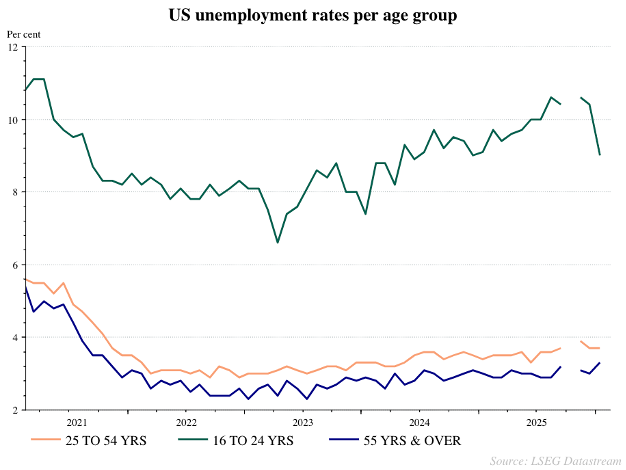
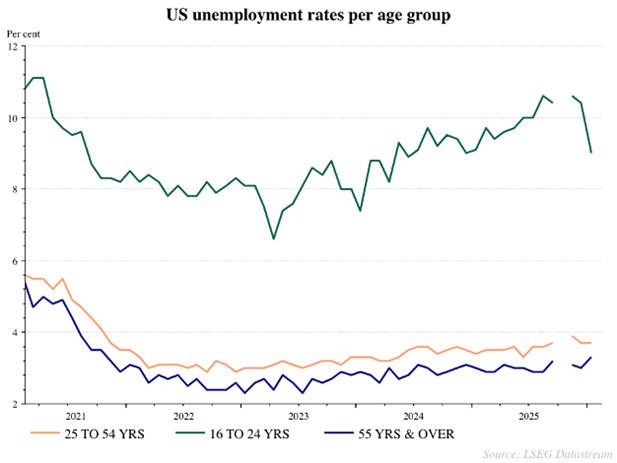
The key question is whether similar patterns are already emerging in our own labour market. To assess this, we look at unemployment data available through December 2025. In the euro area, there is no clear evidence of an AI-related effect on youth unemployment. In Belgium, youth unemployment has edged up slightly since September of last year, but this increase should be interpreted with caution. The increase remains small compared with previous fluctuations. Moreover, unemployment among those aged 25 to 74 also rose marginally, though less pronounced. At the same time, both the participation rate and the employment rate of young people increased in Belgium. In other words, more young people entered the labour force and actively searched for jobs—and many of them found one—resulting in a net rise in youth employment.
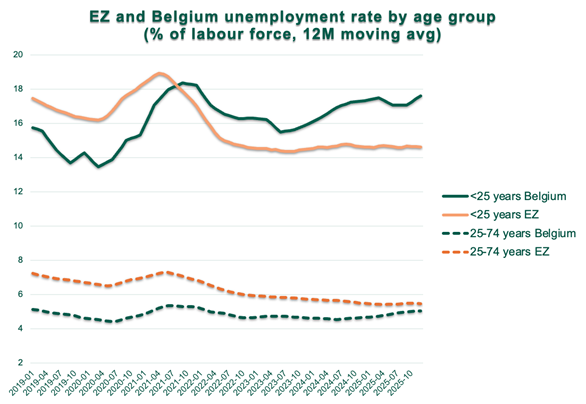
We conclude that the current data do not yet provide clear evidence of a measurable impact of AI on the labour market. One likely reason the still limited adoption of AI among businesses. In 2025, only 35% of Belgian firms were using AI, mainly larger companies.
Looking ahead, AI is more likely to reshape tasks and occupations than to trigger broad-based job losses. New roles are already emerging, including prompt engineers and specialists who train models and oversee algorithmic systems. As a general-purpose technology, AI is also expected to foster new products and services, generating additional labour demand. In a tight and ageing labour market, this could prove advantageous. With demographic pressures set to reduce the available workforce, automation and productivity gains will become increasingly important.
Impact on productivity
If AI is having a direct economic impact, it should be reflected in productivity figures. By automating routine tasks and enhancing knowledge work, AI can generate significant time savings for both employees and firms. In the United States, robust economic growth currently coincides with a softening labour market. Output continues to rise without a comparable increase in employment, pointing to higher productivity. These gains are frequently linked to the rapid adoption of AI in certain sectors.
The services sector, where productivity growth has traditionally been limited, may stand to benefit the most. Automating routine knowledge tasks has the potential to deliver tangible efficiency improvements.
What do the data tell us so far? National productivity figures are currently available only through 2024. In that latest year, productivity growth picked up in several sectors with high exposure to AI, notably ICT and professional, scientific and support services. The acceleration is especially pronounced in ICT. In other sectors that are also investing heavily in AI, such as banking, no clear productivity effects are yet visible.
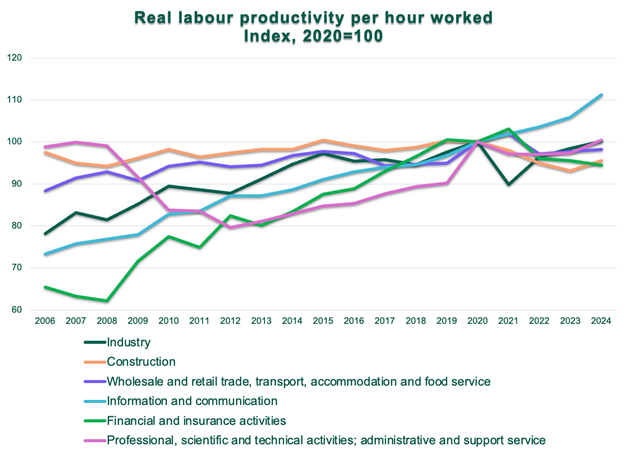
It may simply be too early for the full benefits of AI to show up in the statistics. New technologies rarely translate into immediate, measurable gains. Their impact often follows a J-curve pattern: in the initial phase, investments, learning processes, training and organisational changes weigh on measured productivity. Only after this adjustment period do efficiency gains become apparent.
Economists remain divided on the scale of these gains, and estimates differ substantially. Recent simulations by the European Central Bank[1] point to an additional annual productivity boost of around 0.35% in the euro area over the next decade. Against the backdrop of modest growth in Europe and Belgium, such improvements would be highly welcome.
[1] Bergeaud, A.,González-Torres Fernández, G., Labhard, V. and Sellner, R. (2025), “AI can boost productivity – if firms use it”, ECB blog