Matisse Cappon obtained his M.Sc. in Finance & Risk Management from Ghent University with distinction in 2023, after which, at the same university, he completed the Advanced M.Sc. in Banking & Finance. His master's thesis dealt with the subject of market timing, for which a collaboration was established with Nationale Nederlanden. In November 2024, Matisse joined Econopolis as an equity analyst within the fund team.
Is AI Wrapping Software or Vice Versa?
AI wrappers are going to capture the majority of the value created…
… just like the cloud wrappers did in 2010s.


Source: Jefferies
Introduction
Everything wraps something (except for companies selling sand). Netflix, after switching from renting out DVDs to a streaming service, wrapped the content it licensed from Disney, Comcast, and others. Airbnb wraps accommodations. Amazon.com Retail wraps inventories. And Spotify wraps up the year of its users.
However, they all have one thing in common, i.e. all these applications run on software rails. When the costs of cloud compute dropped during the early 2010s, applications popped up everywhere.
The analogy: Lessons from the Cloud Era
In the early 2010s, a similar skepticism existed. When AWS and Azure began commoditizing compute power, the initial narrative was that value would accrue solely to the infrastructure providers; the "landlords" of the internet. Critics dismissed early SaaS companies as mere "wrappers" of Amazon’s servers.
They were wrong. While the hyperscalers certainly built massive businesses, the explosive variety of value creation happened at the application layer. Uber didn't invent the data center; they wrapped cloud compute and GPS APIs to revolutionize transportation. Salesforce wrapped database hosting to kill on-premises CRM.
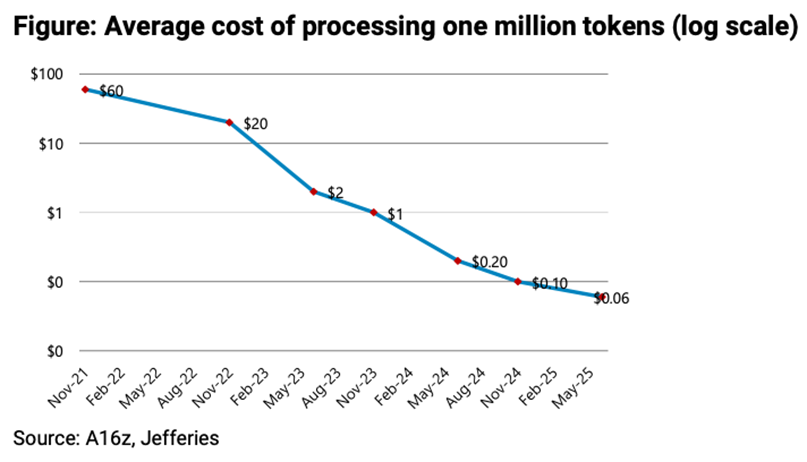
The "Cloud Wrapper" era turned fixed capital costs (buying servers) into variable operating costs. This allowed companies to focus entirely on User Experience (UX) and workflow rather than hardware. We are seeing the exact same dynamic play out now. No one knows whether the Lovables, BASE44s, and Replits (all app vibe coding platforms) of this world will survive in their current form. What we do know is that their input costs, i.e. intelligence and compute, are dropping fast too.
But don’t we want fully integrated AI companies?
There is a valid argument that owning the full stack yields better economics. However, as we move through 2026, the market is splitting into two distinct winning playbooks: The Vertical Giants and the Agile Wrappers.
- Google’s "Vertical" Advantage (2025-2026)
- The Margin Leader: Google has successfully harvested the fruits of its decade-long infrastructure bets. Because they possess the entire vertical stack (from the custom silicon (TPUs) to the Gemini model, all the way up to the distribution layer (Search, Workspace, Android)), their economic reality is different from everyone else’s. While competitors are forced to buy tokens at market rates, Google effectively "rents" its infrastructure to itself at cost. This structural advantage allowed them to deploy AI features aggressively without destroying their margins, a key driver behind their strong stock performance over the last year.
- The "Vertical Trap": However, this integration is a double-edged sword. Google is chained to its own stack. If an external model (for example, a new version of Claude or a breakthrough o1-class model) temporarily wipes the floor with Gemini, Google faces a strategic crisis. They must choose: do they continue pushing their own (potentially inferior) model to protect their vertical margins, or do they pivot to a competitor’s model and surrender their hard-earned hardware advantage? While the "wrappers" are free to chase the best intelligence at the lowest price, Google is wedded to its own laboratory.
- The "Revenge of the Wrappers"
- The (Controlled) Commoditization of Models: The gap between closed and open models has vanished. Llama 3, Llama 4, and other open-source heavyweights have forced a pricing war.
- Software Profitability: Companies like Lovable and Replit have proven you don’t need to burn billions training a model to reach $100M+ ARR. In fact, not owning the model is their advantage. They remain agnostic, instantly swapping in whichever model offers the best price-to-performance ratio that week. As the "token war" drives prices toward zero, the margins for these software wrappers are actually expanding.
- Microsoft's Strategic Pivot: Microsoft increasingly aims at becoming the AI market place of choice. Just like the vibe coding platforms, its customers can choose which foundational AI model they prefer to use, leading to an opposite AI strategy than Google. While initial input costs can be higher, its makes them more(/less) (fr)agile.
Then who are the winners?
In my opinion, even though they already existed before genAI broke through, software infrastructure names remain best positioned for the upcoming AI application boom. Companies like Snowflake (SNOW), Datadog (DDOG), and Cloudflare (NET) are the rails. You cannot run a modern AI app without observability, data storage, and security. They don't care which app wins or which model is used; they get paid on volume. And volume is exploding.
In between the infrastructure and the application layer, some large software “distributors” could also be potentially interesting. Companies like Microsoft (MSFT), ServiceNow (NOW), and Adobe (ADBE) own the customer relationship. They sit between the user and the chaotic model layer. They can swap out a cheap model for a cheaper one in the background, keeping the savings for themselves while charging the customer a premium for the integrated (AI) workflow.
Conclusion
The winners in applications are yet to be determined (and are being built now). However, when looking at the infrastructure layer, winners can already be picked. Thanks to ai revenues exploding, topline starts picking up at some like NET, SNOW, DDOG, MDB, and others. Agentic ai is real and will run on (for the coming years at least) the existing software guardrails. Besides infrastructure software, platforms with the biggest distribution and deepest integration exposure are best positioned (MSFT, NOW, ADBE come to mind).
Disclaimer: This blog post does not contain any personal investment advice or investment recommendations as referred to in art. 2, 9° or 10° of the Act of October 25, 2016, on access to the activity of investment service provider. The information is of a general nature and does not take your personal situation into account. Investing involves risks, including loss of capital. Past performance is not an indicator of future results.
comments powered by Disqus