Five signs that China is getting green, fast
Last week, the question of how green China’s economy really is was raised on the Belgian television programme De Afspraak. Economist Koen Schoors argued that China is becoming greener at a rapid pace, pointing to the scale of its renewable expansion. Other guests were more sceptical, emphasising the country’s continued reliance on coal and its status as the world’s largest emitter. The exchange reflects a broader international debate: is China genuinely transitioning toward a low-carbon economy, or are renewable gains simply layered on top of continued fossil fuel growth?
China is indeed still the world’s largest emitter of greenhouse gases and the largest consumer of coal.1 Yet this fact describes scale, not direction. Over the past five years, renewable capacity has expanded at unprecedented rates, electricity has displaced fossil fuels in key sectors, grid infrastructure has been upgraded, and decarbonisation targets have been woven into national long-term planning frameworks. This acceleration is unfolding at a time when green policy momentum has weakened elsewhere. In parts of Europe, governments are reassessing climate instruments amid economic and political pressure. In the United States, Trump has shifted toward revitalising coal and expanding fossil fuel production. In contrast, here are five signs that China is getting green fast:
1. The energy mix is shifting toward renewables
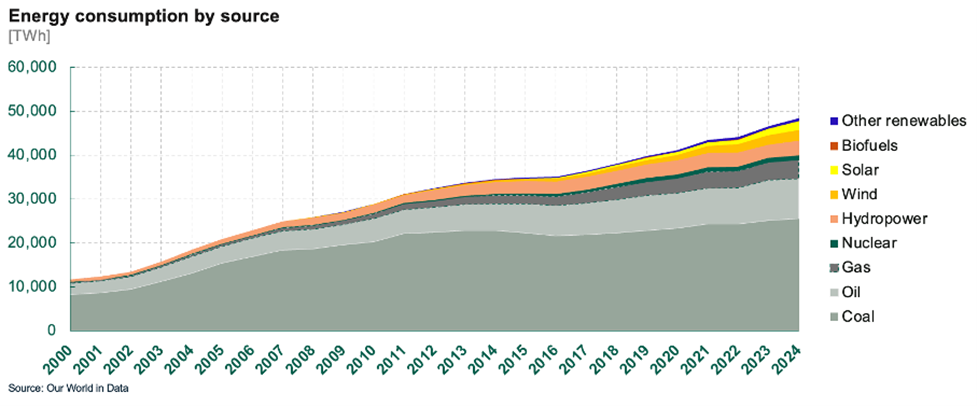
Since 2000, China’s primary energy consumption has more than tripled, rising from roughly 1.2 billion tonnes of oil equivalent to over 3.5 billion tonnes in 2023.2 Coal remains the backbone of the system, supplying around 55–56% of primary energy in recent years.2 Yet the composition of that mix has begun to shift. The share of non-fossil energy in primary consumption has increased from around 12–13% in the mid-2010s to approximately 18–19% in 2024, while coal’s share has gradually declined from well above 60% a decade ago to the mid-50% range.1
Looking ahead, non-fossil energy is expected to gain further ground in China’s total energy system. The share of renewables in primary energy use is projected to reach around 25% by 2030, in line with policy targets. If current trends continue, coal use in China is expected to plateau before 2030 and gradually decline thereafter.1
2. Rising energy demand is being met by renewables, not coal
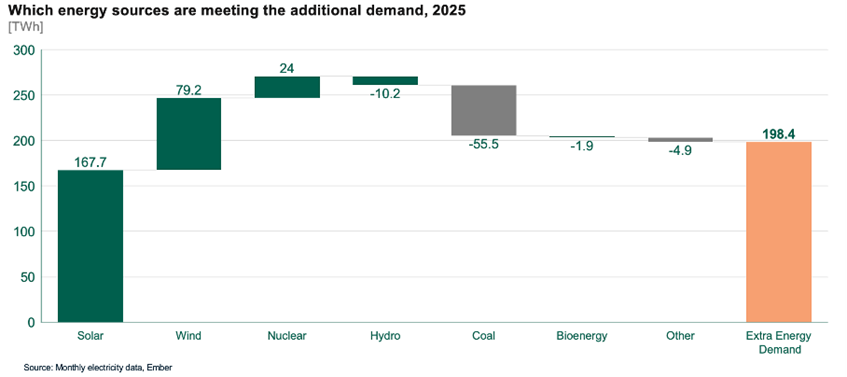
China’s energy demand continues to grow, reflecting its industrial base and rising living standards. The key question is how incremental demand is met. In 2024, clean electricity sources, primarily wind and solar, met 84% of China’s new electricity demand.1 In the first half of 2025, clean generation growth exceeded demand growth, leading to a 2% decline in fossil fuel generation compared with the same period the year before.1
This challenges the frequently cited narrative that China’s transition is merely “additive”, stacking renewables on top of expanding coal. While coal plant approvals remain significant, with 161 GW proposed in 2024,4 utilisation patterns suggest coal is increasingly serving as backup capacity rather than growth capacity.
3. China is by far the world leader in global renewable energy investment
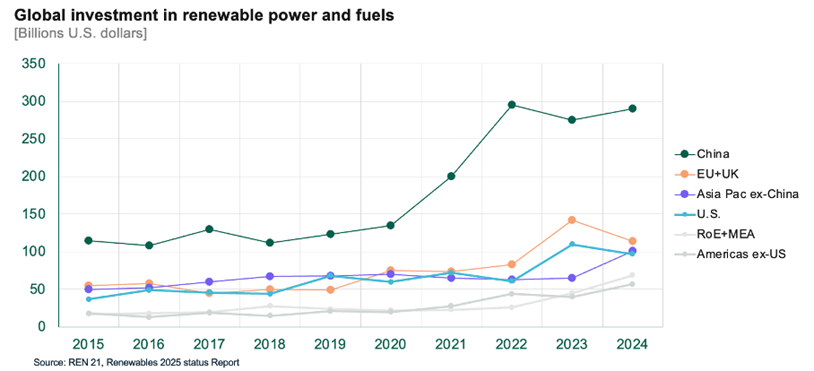
China is the world leader in global renewable energy investment, peaking at over $290 billion in 2024.5 This is nearly three times more than the United States, which saw around $97 billion in investment last year.5 This illustrated by the following statistics:
- Solar is the central pillar of China’s renewable expansion. The country produces roughly 80% of the world’s solar modules, giving it unmatched manufacturing scale.1 This scale is visible in projects such as the enormous solar park that will generate 16,930 MW on the Tibetan Plateau, currently the largest solar cluster in the world, which is expected to be 10 times the size of Manhattan.6
- Wind power illustrates the gap between rhetoric and data. While former U.S. President Donald Trump recently claimed that China “doesn’t have windmills” and relies almost exclusively on coal, official statistics show the opposite. China added 76 gigawatts of wind capacity in 2024 alone.7 Wind now accounts for roughly 16% of China’s electricity generation.7
- Hydropower remains the backbone of China’s renewable system. It accounts for roughly 15–17% of total electricity generation and provides large-scale baseload and balancing capacity.1 China has more installed hydropower capacity than any other country.
- Although nuclear represents a smaller share of the energy mix than wind or solar, expansion plans are substantial. As of 2025, China operates 55–57 nuclear reactors and has 25–30 reactors under construction, the largest buildout pipeline globally.8 By 2035, capacity is expected to roughly double.
4. Electrification is displacing fossil fuels in industry, buildings & transport
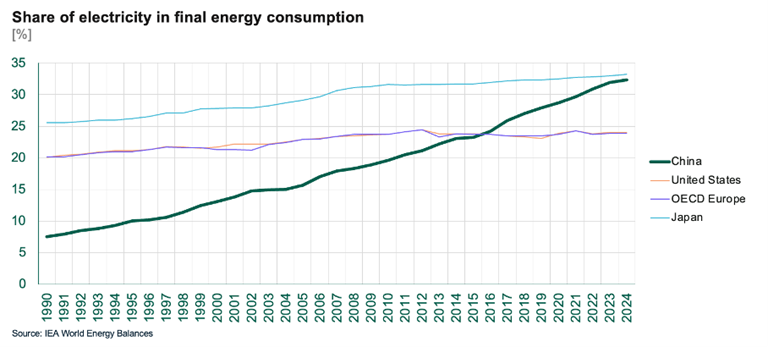
Decarbonisation does not stop at building solar parks and wind farms. It requires replacing fossil fuels in factories, buildings and vehicles, sectors that have historically depended on coal, oil and gas. In China, this change is increasingly visible in how energy is used. Electricity’s share of final energy consumption rose to 32% in 2023, increasing by roughly one percentage point per year since 2015 and exceeding levels in the United States and Europe, both around 24%. 1 In 2023, electricity overtook coal as the largest final energy source in industry.1
This degree of electrification changes how the energy system functions. As transport, heating and industry move from direct fossil fuel use to electricity, overall emissions depend more on how clean the power grid is. The cleaner the electricity supply becomes, the larger the emissions reduction across the wider economy.
5. Policy, geopolitics and prices are locking in the transition
Policy: Long-term planning behind the transition
China’s energy transition is not driven by short-term political pressure, but by long-term state planning. These goals are integrated into national economic strategy rather than treated as separate environmental commitments. They are carried out through what China calls the “1+N” framework.10 The “1” sets the overall direction toward carbon peaking and neutrality, while the “N” translates that goal into specific sectoral and provincial plans, turning targets into detailed responsibilities across the economy.
At the same time, China’s transition is deliberately gradual. Under the “build before break” approach1, renewables, storage and grid capacity are expanded first, while coal shifts toward a backup role rather than being phased out abruptly.
Geopolitics: Energy security as a strategic driver
Geopolitics is one of the most important, and often understated, reasons why China is pushing fast towards renewable energy. China remains highly dependent on imported fossil fuels, particularly oil. More than 70 percent of its oil consumption has come from imports for over a decade.11 Natural gas imports are also substantial, accounting for roughly 40 percent of domestic consumption in recent years.11This dependence creates strategic vulnerability. Much of China’s imported oil and LNG travels through narrow maritime chokepoints such as the Strait of Hormuz and the Strait of Malacca. These routes are exposed to geopolitical tensions, regional instability and potential blockades.
For Beijing, the shift to renewables is therefore not only about climate targets. It is about reducing strategic dependence, strengthening energy sovereignty and insulating the economy from geopolitical shocks.
Prices: Scale driving cost declines
China’s renewable expansion is not only large in volume, but transformative in cost. By leveraging massive manufacturing scale, particularly in solar panels, batteries and wind components, China has driven production costs down sharply. Utility-scale solar and onshore wind are now often cheaper than building new coal-fired power plants.3 The country’s dominance in global clean technology manufacturing has accelerated these price declines. 12 Falling renewable costs therefore do more than lower generation expenses. They reinforce the transition itself: cheaper electricity makes electrification more attractive and strengthens the economic case for continued renewable deployment.
Conclusion
China’s energy system remains large and fossil fuel intensive, but its direction is shifting. The energy mix is rebalancing, most new demand is being met by renewables, electrification is accelerating, and long-term policy and economic incentives are reinforcing the transition.
The question is not whether China is already green. It is whether a structural transformation is underway. The data suggest that it is. And given China’s scale, even gradual shifts in its energy system carry global significance.
Sources
- Ember, China Energy Transition Review 2025
- Our World in Data, “Primary Energy Consumption: China.”
- International Energy Agency, World Energy Outlook 2024.
- CarbonBrief, “Rush for new coal in China hits record high in 2025 as climate deadline looms”
- Statista, “China Pulls far ahead in green energy investment”
- The New York Times, “Why China Built 162 Square Miles of Solar Panels on the World’s Highest Plateau,” 2025
- CNN, report on Yarlung Tsangpo hydropower project
- International Atomic Energy Agency (IAEA) PRIS database 2025; World Nuclear Association, Nuclear Power in China
- World Nuclear Association; China National Nuclear Corporation project documentation on HTGR and ACP100 SMR
- CarbonBrief, “The Carbon Brief profile: China 1+N Policy”
- The Oxford Institute for Energy studies, “The outlook for China’s fossil fuel consumption under the energy transition”
- BloombergNEF, “Global cost of Renewables to continue falling in 2025 as China extends manufacturing lead”