Kristof graduated as a Master of Business Engineering at the University of Antwerp in 2018 (major in Corporate Finance and Financial engineering). In his master thesis, he examined the profitability of a momentum strategy on various government bond markets. Kristof joined the team of Econopolis as a Business Analyst in September 2018, focusing on data management and the follow-up of the latest wealth management technologies. Since 2020 Kristof, became Senior Consultant within Econopolis Consulting, a strategic advisory services with a focus on climate and energy transition.
ETS costs account for 2,8 to 4,3% of Belgian power prices in 2024
Following last week’s industrial summits in Antwerp and Alden Biesen, the ETS system – the European Emissions Trading System for CO₂ allowances – was heavily debated. ETS and CBAM place additional pressure on industry, which is already facing economic challenges, so some actors argue that we should change the rules. Other voices focus more on the “juste retour” principle: the idea that ETS revenues should flow back as much as possible to industry, enabling companies to finance their transition.
High energy costs were also discussed, partly driven by the ETS system. Since 2013, the electricity sector has paid the full price for its emissions; no free allocations have been granted to this sector since then. As a result, ETS costs have increased electricity prices, contributing to a competitive disadvantage. But how much exactly does ETS contribute to the power price? Due to limited available data, we conducted a first analysis ourselves.
To evaluate the impact of ETS on electricity costs, we address 4 questions:
- How do higher CO2 costs lead to higher electricity market prices?
- Why is the impact of ETS on the final electricity price significantly lower?
- What is the total impact of CO2 pricing on the final electricity price?
- What are the key takeaways for the climate transition and industrial competitiveness?
How do higher CO2 costs lead to higher electricity market prices
Before starting the analysis, it is useful to understand how CO₂ costs feed through into electricity prices. In a marginal pricing (or pay-as-cleared) electricity market, generators submit bids reflecting their marginal production costs. These bids are ranked from lowest to highest in what is known as the merit order to meet demand. The price paid to all dispatched generators is set by the last (most expensive) unit needed to satisfy demand - the marginal unit - which determines the market clearing price for that period. As the figure shows, gas-fired power plants often set the price due to their higher marginal costs compared to renewables and nuclear energy. As a result, CO₂ costs are fully incorporated into electricity prices at such moments.
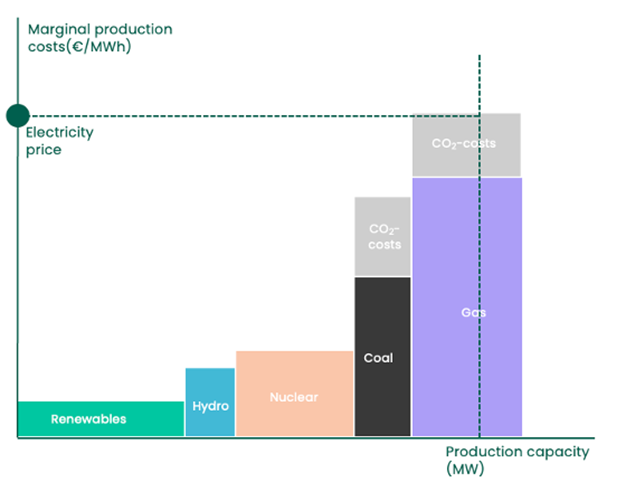
Figure 1: Illustration of the functioning of electricity markets. Source: Ortelius
Belgium has not had coal-fired power plants for some time, but it still has gas-fired plants. In 2024, approximately 18% of electricity production came from these plants, while the remainder mainly came from renewable sources and nuclear energy. Gas is therefore the only energy source in the Belgian mix subject to ETS obligations.
Below, we zoom in on the marginal costs of a gas-fired power plant and the impact of ETS. To estimate marginal costs - and determine what percentage is driven by CO₂ costs - we built a simple model using average annual gas and CO₂ prices for the period 2020–2025. The main drivers of marginal costs are:
- Fuel costs
- Operations & Maintenance (O&M) costs
- ETS costs
This resulted in the following figure:
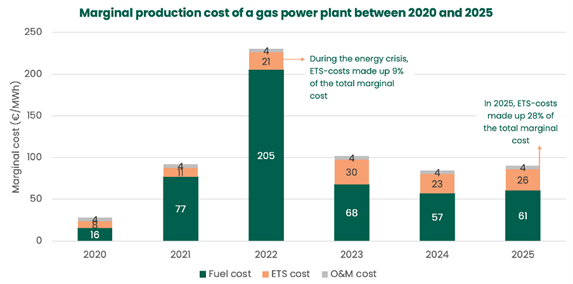
Figure 2: Breakdown of marginal production costs of a gas power plant in the period 2020-2025. Source: Ortelius
During the period 2020-2025, approximately one quarter of marginal production costs of gas plants were attributable to CO₂ costs. We observe a dip in 2022 due to the energy crisis, as the sharp rise in gas prices significantly reduced the relative share of ETS costs.
Naturally, the outcome depends strongly on the country and time period considered. A country such as Poland, where 56% of electricity generation depends on coal and 13,7% on oil and gas, will experience a greater ETS impact in the power sector than a country such as France, which relies on nuclear energy for two-thirds of its electricity and only 3,1% on gas[1].
Looking ahead for Belgium: if gas prices were to fall further to €25/MWh - due to strong expansion of LNG capacity in Europe - and the ETS price were to rise to €100/ton CO₂, the ETS share would rise to 43% of marginal costs. This is certainly not negligible. However, the impact on the marginal cost of a gas plant is not the same as the impact on the final electricity price paid by consumers. More on this in the next section.
Why is the impact of ETS on the final electricity price significantly lower?
Over the past five years, CO₂ costs accounted on average for 23% of the marginal production costs of a gas plant. However, two important reasons prevent us from directly translating this figure into the impact on the final electricity price:
- Gas plants do not set the electricity price every hour of the day.
- The pricing mechanism discussed so far explains wholesale prices, while final electricity prices include many additional charges and network costs.
Gas plants do not set prices every hour (but often do in Belgium)
Around 20% of Belgian electricity generation comes from gas plants, but this does not mean they set prices only 20% of the time. An analysis by Zakeri, Staffel et al. (2023)[1] showed that Belgian gas plants set the electricity price as much as 87% of the time in 2021, while only 20,5% of the generation mix came from gas that year[2]. The following figure shows this for other countries as well. In France, with its dominance in nuclear, gas plants set the price only 7% of the time. The impact of ETS in France is therefore minimal.
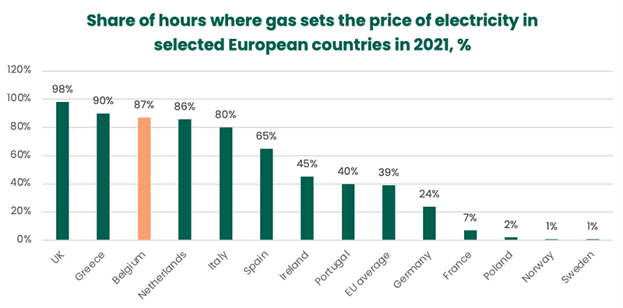
Figure 3: Share of hours where gas sets the price of electricity in selected European countries in 2021, %. Source: Zakeri, Staffel et al., 2023.
The energy component represents at most half of the final electricity price
The puzzle is still not complete, as the final electricity price paid by households and businesses includes more than just the “energy cost” or “wholesale price.” In addition to the energy component, consumers pay levies, VAT, and network tariffs. Below is an overview of the composition of the final electricity price in Flanders: [4]:
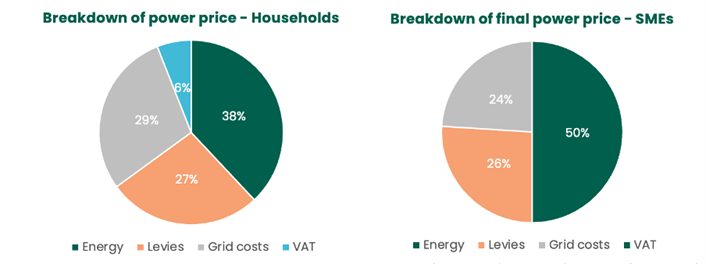
Figure 4: Breakdown of power price in Flanders. Source: https://www.creg.be/nl/consumenten/energiemarkt/hoe-de-energieprijs-opgebouwd. Last update: 01/2026.
ETS only affects the energy component of the electricity bill, which means its impact on the final electricity price is significantly lower than its impact on the wholesale price.
What is the total impact of CO2 pricing on the final electricity price?
To calculate the total ETS impact for households and businesses in 2024, we start from the average CO₂ emissions per kWh of electricity produced in Belgium, calculate the associated CO₂ cost, and compare this to the final electricity price for households and businesses. [5].
This results in a CO₂ cost impact on Belgian electricity prices of:
- 2,8% for households
- 4,3% for businesses
The figure is likely somewhat higher for large industrial consumers, where the energy component carries greater weight. These numbers are consistent with an analysis by the European Central Bank.[6] For 2024, the ECB calculated the impact of ETS costs in overall electricity prices for several European countries, both for households and energy-intensive industries. In Germany, the figures ranged between approximately 5% and 9.5%; in the Netherlands between 7% and 8.5%; and in France between 1% and 1.7%. Lower exposure to fossil energy clearly leads to a significantly lower ETS impact.
What are the key takeaways for the climate transition and industrial competitiveness?
The purpose of this calculation exercise was to gain a first insight - under simplified assumptions - into how ETS feeds through into electricity bills. The remaining question is whether this impact threatens competitiveness. And is ETS the right instrument for industrial transition?
The takeaway is not that ETS is a flawed system, on the contrary. Rather than lowering the ETS impact by attempting to reduce the ETS price, ETS can create stronger incentives to invest in renewable energy and nuclear power plants that do not incur CO₂ costs.
Consider France, where the impact of ETS costs on electricity bills is limited. This approach not only supports the climate transition but also aligns well with a broader European resilience strategy, in which we secure our own energy supply as much as possible.
Sources:
[1] Source: IEA
[2] Source: https://pure.iiasa.ac.at/id/eprint/19109/1/1-s2.0-S2352484723013057-main.pdf
[3] Source: https://www.creg.be/en/highlights-creg-2021-annual-report
[4] Source: https://www.creg.be/nl/consumenten/energiemarkt/hoe-de-energieprijs-opgebouwd
[5]We use an average CO₂ emission intensity of 145 grams of CO₂ per kWh (source: European Environment Agency), a final electricity price for Belgian households of €0.333/kWh and for businesses of €0.218/kWh, and an average ETS cost of €65 per ton in 2024.
[6]Source:https://www.ecb.europa.eu/press/economic-bulletin/focus/2026/html/ecb.ebbox202601_02~a552b71378.de.html
comments powered by Disqus