Gino Delaere is master in Applied Economics (University of Antwerp) and holds an MBA (Xavier Institute of Management in Bhubaneswar, India). For over two decades he has been specializing in emerging markets worldwide and traveling the world looking for interesting investment opportunities. Previously he worked for several large asset managers where he was actively involved in several thematically inspired equity funds. He joined Econopolis in 2010 and in his current role he is co-responsible for managing the emerging markets and climate funds.
Move over Mag 7, here come the Asian Mag 5
The Magnificent 7 (Nvidia, Apple, Microsoft, Alphabet, Amazon, Meta, Tesla) have dominated US and global equity returns in recent years, with a massive impact on broad indices. In some years, this group delivered more than half of the S&P 500’s gains while rising to over 30% of index weight by mid‑2025, illustrating unprecedented concentration in a benchmark designed to be diversified. Their combined market capitalization has soared into the trillions, reshaping indices and investor portfolios alike. This has been a big headache for active global investors as it has been very difficult to outperform US and global indices without exposure to these names.
Yet, while Wall Street’s Mag 7 has grabbed all the headlines, a quieter but equally transformative story has unfolded in emerging markets (EM). A relatively narrow Mag 5 cohort of Asian technology and platform champions have contributed a very large share of MSCI EM’s overall gains in 2025, analogous to the US Mag 7’s dominance of S&P500 returns. More than 40% of the contributions to the MSCI EM’s performance last year was delivered by TSMC, Samsung Electronics, SK Hynix, Tencent and Alibaba. So what this basically means is that if we multiply the weight of these companies in the MSCI EM index, and we multiply this with their performance during 2025, we reach a total of 42%. That is the part of MSCI EM index performance which was driven by just these five companies. And they were all Asian: one Taiwanese, two South Korean and two Chinese companies. Hence, withouth these five companies, EM index returns would have looked materially weaker, revealing an equity landscape where AI, cloud and digital platforms increasingly determine the overall performance of a broad index. As this Mag 5 phenomenon has been much less documented in the western media compared to the widely talked about Mag 7, we thought it might be interesting to talk about the Asian Mag 5 for a change.
There are both structural and cyclical reasons why these five companies have come to dominate EM benchmark performance in recent years. Historically, EM indices were more diversified across commodities, financials and cyclicals. But that has changed. As global hyperscalers (Google, Amazon, Microsoft, Meta) ramped up AI capital expenditures into the hundres of billions, boosting demand for advanced semiconductors and memory, Asia’s supply chain has captured much of this spend. The result is that unlike prior EM cycles tied to China’s property or commodities, we are now in an AI-driven and export-oriented cycle. What these five companies have in common, is that they sit at the core of the AI stack. TSMC is the leading advanced foundry for AI chips, while Samsung Electronics and SK Hynix are among the world’s top memory producers, crucial for training and inference. At the same time, Alibaba and Tencent are developing their own large language models and cloud ecosystems, creating integrated demand for compute and storage. Their index weights have also compounded over the years. Several of them have in fact seen their weight in the MSCI EM index more than double. So let’s dive a bit deeper into each of these companies to find out what have been the triggers for their performance.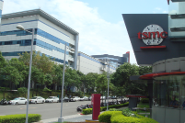
Foto’s van meest recente bezoek aan hoofdkantor TSMC in Taipei, Taiwan (Bron:Gino Delaere)
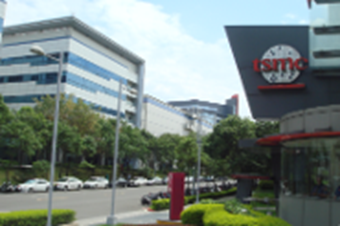
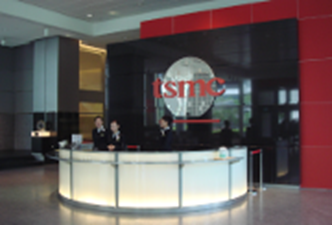
- TSMC, the AI foundry backbone
Taiwan Semiconductor Manufacturing Company (TSMC) is the world’s largest dedicated semiconductor foundry and simply incontournable in the global AI supply chain. What this means is that they are basically the world’s largest contract chipmaker. They don’t design chips, but manufacture them for clients like Nvidia, Apple, AMD and Broadcom. Its technological leadership cannot be questioned. The company remains at the frontier in advanced process nodes, critical to making high‑performance, energy‑efficient chips for AI and high‑performance computing. Its scale and pricing power enable strong margins and returns, with sustained strong double‑digit earnings growth, supported by structural tailwinds like increasing AI adoption, cloud build-outs, chip content growth in automotive and industries, IoT demand, and the list goes on. Their monopoly-like position in cutting edge foundry therefore suggests they remain very well placed to benefit from a multi-year AI capital expenditures supercycle.
- Samsung Electronics, a diversified AI hardware leader
Samsung Electronics is a diversified technology giant spanning memory chips, foundry, consumer electronics, and mobile devices, which gives it multiple avenues of exposure to the AI and digital‑device upgrade cycle. On the semiconductor side, they are the world’s largest memory chipmaker by output and a major producer of DRAM and NAND, both essential for AI servers and data‑centric infrastructure. In 2025, recovering memory prices and growing AI‑server demand drove a sharp rebound in profitability in Samsung’s (typically very cyclical) memory division, with operating profits in that unit approaching new records. If the AI‑driven memory upcycle continues, and if Samsung executes on its roadmap and strengthens its foundry offering, the company has scope to deliver margin expansion and strong earnings growth. That in turn would support a sustained role as one of the key return engines of the EM universe.
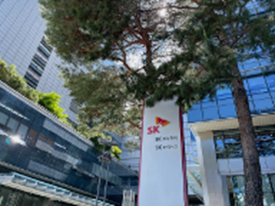
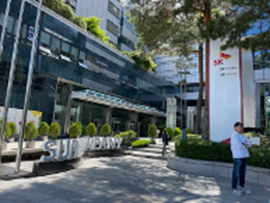
Foto’s van meest recente bezoek aan hoofdkantor SK Hynix in Seoel, Zuid-Korea (Bron:Gino Delaere)
 .
. 
3. SK Hynix, the pure play in AI memory
The other South Korean company in the Mag 5 is SK Hynix. They are much more narrowly focused than Samsung Electronics, concentrating primarily on memory chips and have become one of the purest “AI memory” plays in global equities, thereby becoming somewhat of a crowded trade in the short term. It is a core supplier of high‑bandwidth memory (HBM), putting it at the heart of the infrastructure build‑out for training and inference clusters. By 2025 SK Hynix’s profitability had recovered to the point that it overtook Samsung Electronics in annual profits for the first time ever. If AI adoption remains robust and if SK Hynix maintains a technological and product lead in HBM and advanced DRAM, it could continue to grow fast.
4. Alibaba: e-commerce, cloud and AI
Alibaba began as China’s dominant e‑commerce and online marketplace platform, and has since expanded into cloud computing, digital payments and enterprise services, creating a broad digital‑economy ecosystem. Indeed, in recent years Alibaba has invested heavily in cloud infrastructure and AI capabilities, including developing large language models to provide AI services to merchants and enterprises. While China’s macro and regulatory environment have been challenging, by 2025 Alibaba’s share performance had turned more positive, supported by restructuring efforts, renewed focus on shareholder returns, and growth in higher‑margin cloud and services segments. The long‑term thesis for Alibaba is that it sits at the intersection of Chinese consumption, digital services and AI‑enabled enterprise software, all multi‑year trends that could continue to compound.
5. Tencent: China’s super app and digital ecosystem
Tencent is a Chinese internet conglomerate best known for its WeChat super‑app, online gaming and digital entertainment businesses, along with a large portfolio of minority stakes in other tech firms. Like Alibaba, it is a core way for global investors to access China’s digital‑service growth. WeChat’s integration of messaging, payments, mini‑programs and services makes Tencent central to daily life for hundreds of millions of users, and that engagement underpins its advertising, fintech and gaming revenue. Tencent is also investing in generative AI, developing its own models and integrating AI tools into its platforms to improve user engagement, advertising efficiency and developer productivity. If it can continue to monetise its ecosystem, expand in cloud and enterprise services and harness AI to deepen engagement and efficiency, Tencent’s earnings and cash flows may grow meaningfully faster than the broader EM market.
In conclusion, it certainly looks like these companies have plenty of runway for growth and therefore may continue to behave similarly to the Mag 7 have over the past couple of years. But let’s not overlook the risks. Geopolitical tensions around Taiwan for instance, or Chinese regulatory and macro uncertainty are just the most obvious reasons why this might not continue to evolve so smoothly. South Korea on the other hand is highly dependent on energy from the Middle East. Hence, if the Iran war doesn’t end in the near future, that might become a significant bottleneck for critical inputs like helium. Or maybe everyone is overlooking the classic cyclicality of semiconductors which could much create more volatility to the downside. All of this is true, and we could even list even many more uncertainties. Still, in terms of structural positioning within the global AI and digital economy, these five companies are arguably as critical to EM as the Mag 7 are to the US. If global hyperscalers continue to ramp up AI capital expenditures, they will continue to demand advanced semiconductors and memory, and Asia’s supply chain will continue to capture a lot of this spend. The two Chinese names in the Mag 5 have somewhat different drivers, offering exposure to China’s 1.4 billion digital consumers, and they are well positioned to benefit from China’s cloud and platform recovery. The Mag 5 story therefore seems far from over, and these five Asian titans may well write the next chapter in global market leadership.
About the author

Gino Delaere
comments powered by Disqus