#MacroFriday: European Inflation
Good Friday! This week, the first estimates of European inflation for March were published, and we looked for indicators of a resurrection in inflation (although it wasn't declared death yet). Rising energy prices, driven by the conflict in the Gulf region, are beginning to feed through into consumer price levels.
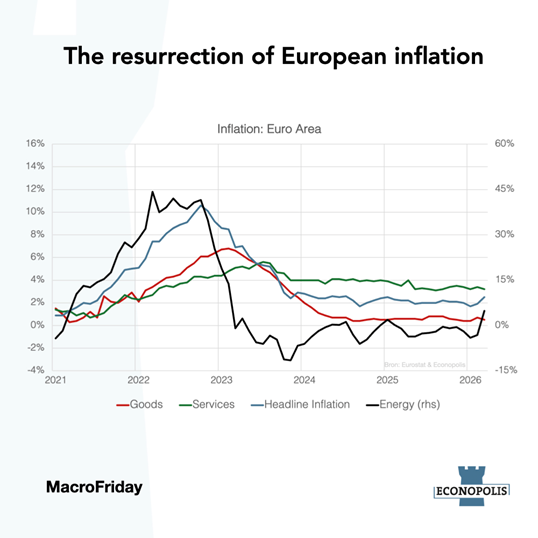
European inflation increased from 1.9% in February to 2.5% in March. In February, energy prices were still 3.1% lower than a year earlier, whereas in March they were already 4.9% higher year-on-year. In goods and services, upward pressure remained limited, although services inflation, at 3.2%, is still clearly too high. A comparison with the situation four years ago is not appropriate at this stage: the economy was not paused and restarted, the M2 money supply did not expand explosively as it did back then, monetary policy is currently more neutral to restrictive, and governments have limited fiscal space to implement similar support measures.
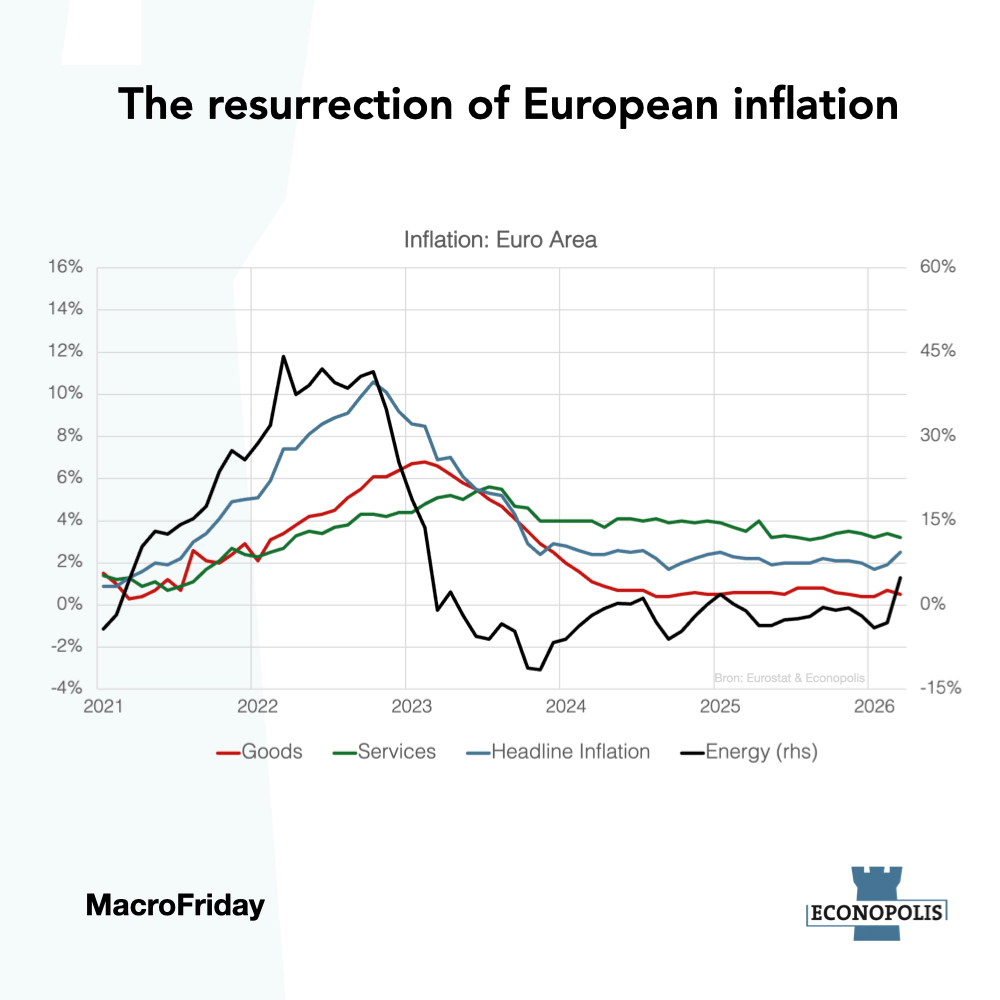
Under current circumstances, it is becoming difficult for the ECB to maintain its long-standing credo of “We’re in a good place.” However, it will only adjust short-term interest rates, through which it primarily influences demand in the economy, once there are clear signs of spillover effects in the prices of other goods and services. Still, financial markets are already pricing in a rate hike for the ECB’s policy decision at the end of this month.
According to Statbel, Belgian inflation rose only modestly in March, from 1.45% to 1.65%. Although energy prices also increased sharply in Belgium, these effects are passed on to consumers with a delay. As a result, Belgian inflation is likely to pick up more strongly in April. Moreover, the risk of second-round effects is increasing in Belgium due to the system of automatic wage indexation, especially if this conflict persists. This remains the case even if energy prices were to decline again in the event of a de-escalation scenario in the Gulf region as it makes the labour cost for Belgian companies even more expensive on a relative base.
Happy Easter!