Bram Tankink behaalde in 2000 zijn propedeuse hydrologie aan de Universiteit Wageningen, waarna hij zich tijdelijk toelegde op het wielrennen. In 2001 werd hij profwielrenner bij Domo Farm Frites en reed hij achttien jaar als professioneel renner. Aan het einde van zijn sportcarrière verlegde Bram zijn focus naar duurzaam investeren en was hij medeoprichter van het ORE Fund, een fonds dat zich richt op duurzame energieprojecten in Nepal en later ook in Bangladesh. Na zijn wielercarrière ging hij aan de slag als projectleider bij de Brightlands Chemelot Campus en werd hij bestuurder bij Stichting Symbio, die zich richt op circulaire start-ups en de energietransitie. Sinds mei 2025 is hij als business developer werkzaam bij Econopolis.
Whoever Has the Electrons Has the Future
Last week, I noticed the following news item.
"Approximately 45 data centers in the Netherlands use as much electricity as nearly 1.9 million homes, according to the Central Bureau of Statistics. Data centers are consuming more and more electricity: in 2017, they accounted for 1.2 per cent of total electricity consumption, while last year that figure rose to 4.2 per cent."
Source: NOS
It is striking that the electricity consumption of data centers accounts for such a large share of total power consumption. The fact that this has grown to 4.2% in a country that is currently facing a shortage on the electricity grid is remarkable. Even outside the most densely populated areas of the Netherlands, businesses and homes can no longer be connected to the grid. In some places in the south of the Netherlands, it currently takes up to 70 weeks for a new-build home to obtain a grid connection.
Data centers and the limits of the electricity grid
This raises the question of whether homes, schools and manufacturing companies should not be given priority over data centers when it comes to access to electricity, rather than the other way around. The electricity applications by data centers were submitted in the past, and the grid reservations allocated to them remain in place. All of this is happening in a relatively small country that is generally seen as tightly organised. I was surprised that data centers in the Netherlands play such a significant role in electricity consumption, because when it comes to AI and data centers, the discussion usually focuses on the US.
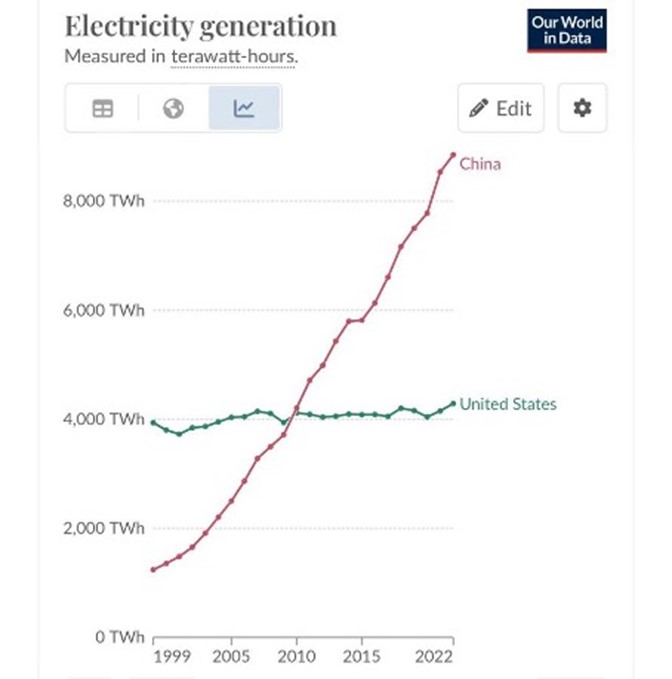
Wouldn’t we face the same problem in the US? A country that is the world’s largest energy consumer appears to have invested very little in infrastructure in recent years. Compared with China, which has gone all-in on solar and wind energy, but also on coal and gas, the contrast is striking. See graph.
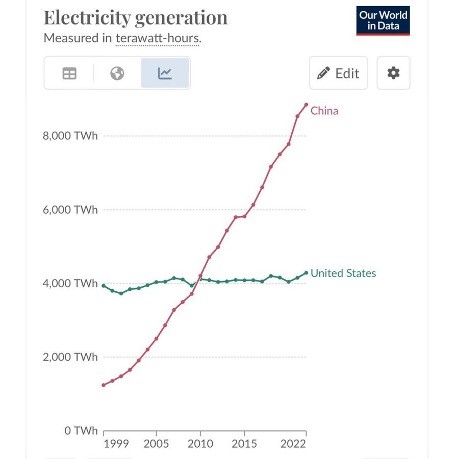
The US risks repeating Europe’s energy mistakes
Won’t we encounter the same problems in the US as in the Netherlands? Given how much China has invested, the US will have to make massive investments as well; otherwise, it risks losing the race for cheap, accessible energy to power AI.
The US would need to change course quickly. Hydropower, for example, could be one area to look at. However, given the long period of underinvestment in infrastructure, this is far from a quick fix. Renewing licenses or building new hydropower capacity can take up to eight years. The US was once a strong player in hydropower, but due to a lack of investment and the impact of climate change, many hydroelectric power stations are now at risk of losing generation capacity. The average age of US hydropower facilities is around 65 years, and many operating licenses are expiring. New laws and regulatory requirements for license renewals demand substantial capital expenditure, and an increasing number of operators can no longer absorb these costs and are choosing to surrender their licenses instead.
"And in parts of the US where water is becoming scarcer as the climate warms, reservoirs are drying up. Hydropower output in the American West hit a 22-year low last year after below-average snowfall, according to analysis by the Energy Information Administration. Yet other parts of the US, such as the Northeast, are getting wetter as the planet heats up."
Source: Canary Media
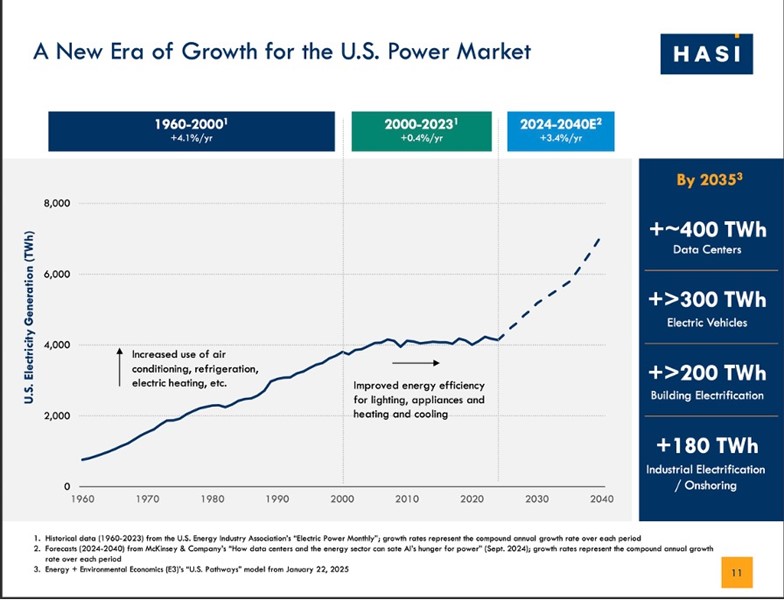
A deeper dive into electricity consumption and generation in the US reveals the following (see graph 2). From 1960 to 2008, electricity consumption increased from approximately 1,000 TWh to 4,000 TWh. That is a rise of 3,000 TWh over 48 years. After 2008, growth largely stabilised and has remained flat until recently. This was mainly the result of more efficient electricity use, particularly through household and industrial appliances. When energy prices are not a binding constraint, efficiency gains are realised relatively quickly once more efficient technologies are adopted.
During this period, generation capacity continued to be added, primarily through wind and solar power. However, much of this new capacity served as a replacement for ageing power stations that were taken offline, rather than as net additions to the system. Last year, wind and solar accounted for 87% of new generation installations.
More recently, electricity demand has started to increase again. Current estimates suggest that an additional 1,100 TWh of generation capacity will be required over the next ten years: roughly 400 TWh for data centers, 300 TWh for electric mobility, 200 TWh for electrification in buildings, and 110 TWh for electrification in industry. Beyond AI, robotics is also expected to become a significant driver of electricity demand.
Source: HASI Annual Report
Bottlenecks as catalysts for innovation
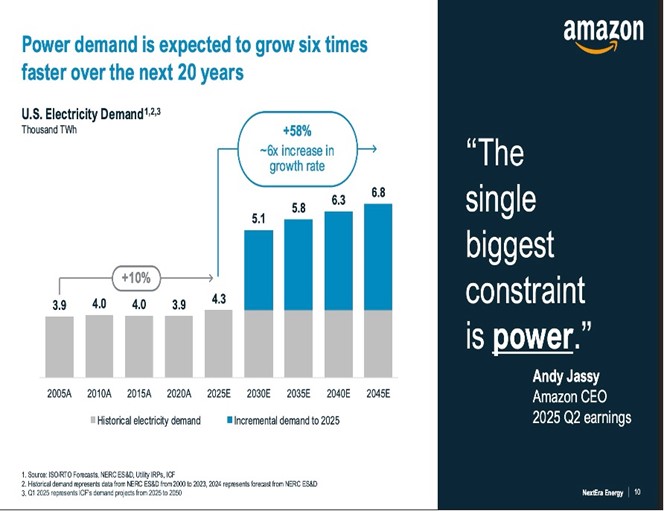
Where will the growth in electricity generation come from? Recently, there has been a growing number of headlines suggesting that the expansion of data centers is being constrained by a lack of available electricity, and that new data centers simply cannot be connected to the grid. As a result, off-grid solutions, such as those provided by Bloom Energy, are gaining traction.
Progress rarely follows a straight line. Growth in one sector is often stronger than anticipated, creating bottlenecks elsewhere in the system. These bottlenecks then need to be resolved, only to be followed by the next constraint. The key question is whether one approaches this dynamic in terms of problems or in terms of solutions.
Last week, the idea of data centers in space was presented as a potential solution, alongside speculation about a possible IPO of SpaceX. But how realistic is it to launch heavy systems into orbit and operate them there? How do you replace chips that fail? It is not straightforward to send a maintenance engineer into space for a quick repair. Moreover, companies consistently indicate that they want data centers to be located as close as possible to where data is generated or consumed. All of this makes space-based data centers an unlikely and extremely expensive scenario.
Source: Investor Day Nextera
The beauty of bottleneck mechanisms is that they force innovation. At the same time, massive investments in infrastructure will be required in the US. This is badly needed, as too little has been done in recent years and ageing power stations risk being taken out of service, including the hydropower facilities mentioned earlier. Part of this loss in capacity can be offset by replacing these power plants with wind and solar energy, combined with storage solutions.
Until recently, solar energy was seen as the revolution of the future. In the Netherlands, however, an abundance of sunshine led to excessive peaks on the grid, effectively limiting further growth in solar capacity. The solution emerged once storage capacity came online and peak production could be scaled back through curtailment. Solar energy has faced significant resistance throughout its short history, it was deemed too expensive and too complex, yet it has turned out to be the cheapest form of energy available.
Recent market narratives have been dominated by potential bottlenecks and proposed solutions, questions about whether AI represents a bubble, and more speculative ideas such as data centers in orbit, alongside more tangible developments like improved AI models and more energy-efficient AI chips. As a result, increasingly stark doomsday scenarios are starting to emerge.
Source: Guy Massey.
I just informed a Fortune 500 CEO that his data centers are worthless. He laughed. Then I showed him NVIDIA's power specifications. He stopped laughing.
GB200 NVL72 racks pull 120kW. His entire facility was designed for 10kW per rack.
"That's like trying to power a jet engine with a car battery".
𝗛𝗲𝗿𝗲'𝘀 𝘁𝗵𝗲 𝗕𝗿𝘂𝘁𝗮𝗹 𝗥𝗲𝗮𝗹𝗶𝘁𝘆 (𝗶𝗻 𝗣𝗹𝗮𝗶𝗻 𝗘𝗻𝗴𝗹𝗶𝘀𝗵)
• In just 5 years we've gone from 10kW per rack to 100kW+
• Air cooling at 100kW = using a desk fan on a blast furnace
• One AI cluster now pulls more power than 50,000 homes
• Your local substation just became the bottleneck
Solutions always follow problems and bottlenecks, never the other way around. This week, I read that Nvidia’s new Blackwell chips require so much cooling that there is already a shortage of the materials needed to cool them, meaning the chips cannot yet be installed at scale or within expected timelines. At the same time, multiple companies are working on new cooling techniques. Heat-pump manufacturers, for example, already possess much of the required expertise. If these constraints become severe enough, they will also incentivise chipmakers to accelerate the development of more energy-efficient architectures.
There is also a broader question: what if data centers not only consume electricity, but actively support the power grid through smarter demand management?
“Renewable energy, which is intermittent and variable, is easier to add to a grid if that grid has lots of shock absorbers that can shift with changes in power supply,” said Ayse Coskun, Emerald AI’s chief scientist and a professor at Boston University. “Data centers can become some of those shock absorbers.”
The idea that new electricity generation will primarily come from coal, gas or even nuclear power is understandable, as this has often been the case in the past. Looking forward, however, this appears less likely. Given the enormous power requirements ahead, the system will gravitate towards the cheapest available sources. Today, that means solar and wind, increasingly combined with battery storage, and new natural-gas power plants coming online around 2030. Coal and nuclear power rank far higher on the cost curve, while new small modular reactors (SMRs) are unlikely to be meaningfully available before 2035.

Source: HASI annual report
From energy constraint to investment opportunity
Upgrading the grid and building additional electricity-generation capacity and infrastructure require long planning cycles and substantial capital expenditure. This cannot be achieved overnight. Given the scale of demand ahead, a period of sustained and stable growth in electrification will be necessary in the coming years.
As a result, companies such as Eaton, Schneider Electric, Daikin and Hitachi are likely to see structurally strong and steady demand for their products and services. Major renewable-energy players, such as NextEra, will take on many additional gigawatts of capacity, while wind and solar developers should experience rising order books in the years ahead.
Over the past six months, we have already seen a clear shift in market sentiment: from an anti-climate policy and investment thesis towards a focus on opportunity. This places the Climate & Resilience fund in a strong position to benefit from potential growth linked to data centers, as well as the broader electrification of industry and mobility.
The key question is no longer whether the renewable-energy market will grow, but how quickly it will grow and how fast existing bottlenecks can be resolved. The rapid build-out of data centers, combined with mounting grid constraints, will inevitably trigger a new wave of innovation, particularly in energy efficiency, grid flexibility and power management. As electrification becomes increasingly intertwined with technology and AI, these dynamics will play a central role. Grid flexibility, in particular, will become a priority, creating opportunities for both new entrants and established innovative players.
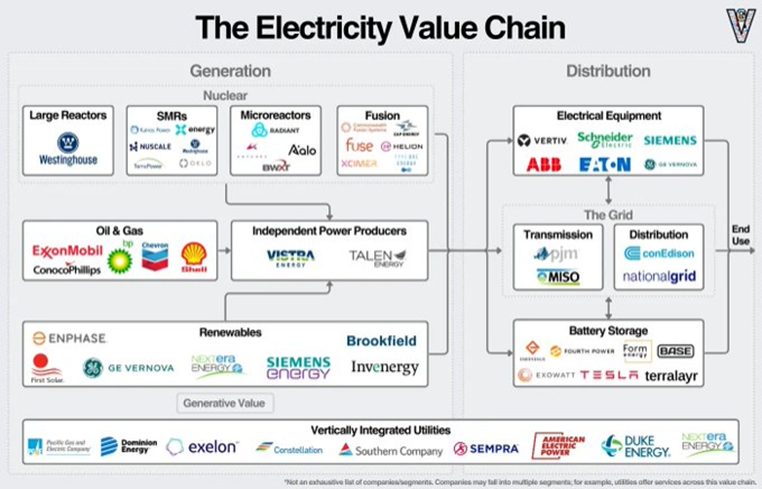
Whoever has the electrons has the future. The future looks bright!
About the author
Bram Tankink
comments powered by Disqus