Senior Economic Consultant at Ortelius
What We Get Wrong About Data Centers - and How to Fix It
Data centers have become convenient villains in the public debate. They are blamed for overloading the grid, worsening congestion, consuming “too much” electricity, and wasting heat that evaporates uselessly into the air. And yes, these concerns come from real pressures: Europe’s electricity grids are strained, clean generation is lagging behind demand, and many data centers still rely on outdated cooling systems that bleed energy. Add the explosion of AI compute on top of that, and it’s no surprise the public sees data centers as energy parasites. But this perception is wrong, not because the concerns are imaginary, but because the assumptions behind them are outdated.
The problem is not that data centers use a lot of electricity. The problem is where that electricity comes from and how their heat is handled. If we keep feeding massive compute loads through fossil-heavy, congested grids, of course the system strains. If we continue rejecting high volumes of constant, predictable heat, of course it looks wasteful. But these aren’t immutable characteristics of data centers, they are symptoms of poor system design. The moment we rethink how and where data centers plug into the energy system, the entire picture changes.
The first shift is simple but profound: stop pulling energy through the public grid, and start generating it locally. Co-locating data centers with renewables, solar, wind, or hybrid setups, helps reduce grid pressure. When directly connected, they avoid injecting power into already-congested networks. But this model has limits: renewables can’t be placed everywhere, they require vast amounts of land, and they cannot provide the stable production profile that high-performance compute needs. That is why the real breakthrough, the one that actually unlocks 24/7 carbon-free compute, is Small Modular Nuclear Reactors.
SMRs offer everything modern data centers and AI clusters require: stable baseload, carbon-free electricity, compact footprints, and round-the-clock reliability. Pairing a data center directly with an SMR decouples its load from the grid entirely. No congestion. No fossil backup. No political drama every time demand grows. For Europe, this pairing represents more than technical efficiency, it is a strategic advantage, merging clean, sovereign energy with sovereign digital infrastructure.
And electricity is only half the story. The other half, the one almost everyone ignores, is heat. Data centers are constant, reliable heat factories. Today, that heat is treated as a nuisance; tomorrow, it should be treated as a resource. Instead of burning gas in dense cities or forcing millions of households into expensive, space-constrained heat pumps, we could pipe data center heat directly into district heating networks. Up to 75% of data centers waste heat can be recovered to heat households.[1] Operators cut cooling costs, cities slash emissions, and citizens get stable, affordable heat. Scandinavian cities have already proven this works. Microsoft is building a cluster of datacenters in Finland that could heat up to 40% of households in Finland’s second largest city, Espoo.[2]
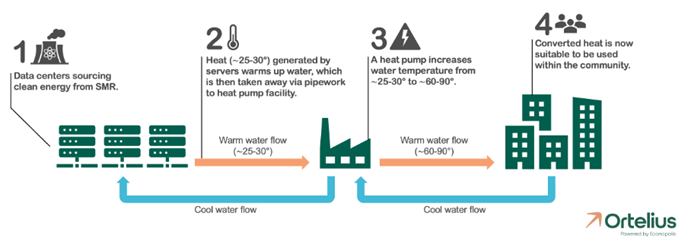
Figuur 1: Heat recovery from data center to city (Source: Equinix)
Data centers and AI are not going away, their demand will keep rising. Pretending otherwise only pushes them elsewhere. And if Europe tries to repel data centers instead of integrating them, it will lose control over its data, fall behind in AI capability, and export both emissions and economic value to regions with cheaper energy and weaker climate rules. That would be a self-inflicted wound to European competitiveness and security.
Hosting the next generation of data centers in Europe is not optional, it is a necessity. But hosting them responsibly means designing around them, not resisting them. With SMR-powered compute and full heat recovery, data centers don’t strain the system; they enhance it. They become anchor loads that stabilize renewable grids, reliable heat suppliers for communities, and core pillars of Europe’s digital resilience.
A properly designed data center is not a burden, it is a strategic asset. Europe can keep treating them as villains, or it can redesign its energy system to transform them into one of the most powerful tools for decarbonization, competitiveness, and sovereignty we have. Those who understand this early will shape the future. Those who don’t will simply watch it be built elsewhere.
At Ortelius, we track how the world economy is changing and give organizations the insights they need to navigate, and lead, the system that’s emerging.
Sources:
Equinix. (2024, June 5). What is data center heat export and how does it work? Equinix Blog. https://blog.equinix.com/blog/2024/06/05/what-is-data-center-heat-export-and-how-does-it-work/
Fortum. (n.d.). Data centres, Helsinki region. Fortum. https://www.fortum.com/data-centres-helsinki-region
Ravi, S. S., Loffler, T. S., Pina, E. A., Sharma, S., Lepour, D., Terrier, C., & Maréchal, F. (2026). From servers to services: Modeling data centers as heat-active urban energy prosumers. Applied Energy, 402, 127049. https://doi.org/10.1016/j.apenergy.2025.127049
World Economic Forum. (2024, February). Harnessing waste energy from data centres. World Economic Forum. https://www.weforum.org/stories/2024/02/harnessing-waste-energy-data-centres/
International Renewable Energy Agency. (n.d.). Waste heat recovery from data centres. In Innovation landscape for smart electrification: Power-to-heat and cooling. https://www.irena.org/Innovation-landscape-for-smart-electrification/Power-to-heat-and-cooling/31-Waste-heat-recovery-from-data-centres
Bloomberg. (2025, May 14). Finland’s data centers are heating cities, too. Bloomberg. https://www.bloomberg.com/news/features/2025-05-14/finland-s-data-centers-are-heating-cities-too
[1] Source: Fortum
[2] Source: Bloomberg
comments powered by Disqus