#MacroFriday: The last mile in Euro Area services inflation
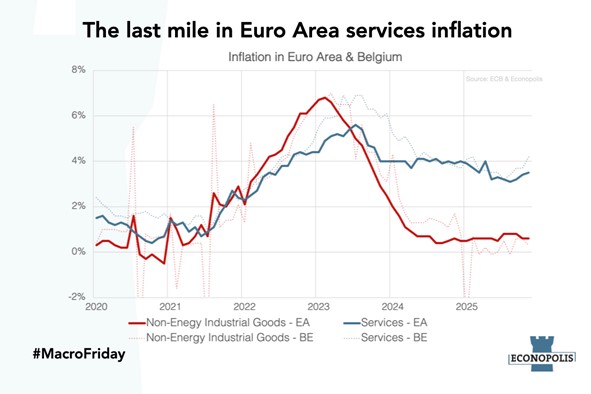
The inflation crisis in the Euro Area is over, but the real story is how stubborn services price inflation has become.
On Tuesday, Eurostat published its flash estimate for euro area inflation in November, which came in at 2.2% year-on-year, up slightly from 2.1% in October. The HICP inflation estimate for Belgium stood at 2.6%. While inflation remains above the ECB’s target, it is close to target after the exceptional cycle in recent years: inflation averaged close to zero in 2020, then surged following the reopening of the economy and the energy shock to over 8% in 2022, before falling back slowly towards 2–3% in 2024–25 as energy prices normalised. With inflation remaining above target and no significant weakening in the labour market, this leaves the ECB in no hurry to cut interest rates at its next meetings.
Since early 2024, the inflation story in the euro area has been one of services versus goods. Services inflation has hovered around 3–4% and recently picked up again towards 3.5% in November, highlighting strong domestically driven price pressures via wage growth and still tight labour markets. Meanwhile, non-energy industrial goods have shown low inflation rates and, together with negative energy inflation rates, have kept headline inflation in check. In its September 2025 projections, the ECB expects headline inflation to ease to 1.7% in 2026, before edging back to 1.9% in 2027, assuming wage growth gradually slows and goods disinflation persists. That means inflation is now broadly normalised, but the pace of services disinflation in 2026 is the key variable to watch.