#MacroFriday: Fed cuts rates again as balance sheet contraction ends
On Wednesday, the Federal Reserve Committee delivered the third consecutive rate cut in the last three meetings, bringing its key policy rate to a range of 3.5%–3.75%. Fed Chair Powell indicated increasing tensions between the two targets of its dual mandate: rising inflation, mainly due to tariffs, and weak labour market conditions, resulting in diverging views on monetary policy among Fed governors. Still, the Fed’s projections for the US economy in 2026 were adjusted higher as consumer spending continues to hold up and AI investments boost business investment.
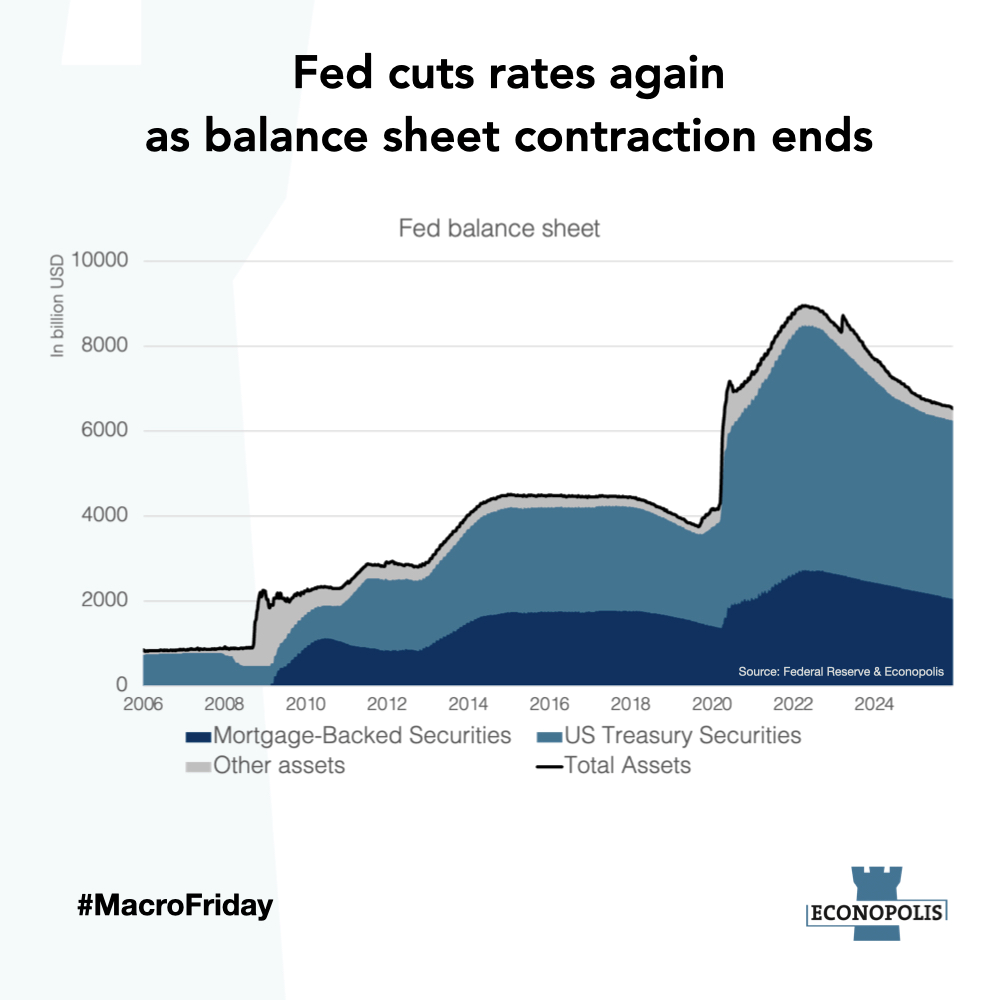
Besides the Fed’s interest rate decision, the Committee decided to initiate purchases of shorter-term Treasury bills to maintain an ample supply of reserves over time and dampen stress in money markets. It announced the purchase of $40 billion in T-bills in December and additional purchases in the coming months. At the October meeting, the Federal Reserve had already decided to conclude its reduction of securities holdings at the beginning of this month. As the graph shows, since June 2022, the Federal Reserve’s total securities holdings declined by more than $2.2 trillion, a move aimed at draining excess liquidity from the economy and dampening inflationary pressures. This represents a reduction of more than a quarter of its balance sheet since its peak in 2022.
Now that this balance-sheet reduction has stopped, the Fed will roll over all principal payments from its holdings of Treasury securities and reinvest all principal payments from Mortgage-Backed Securities into Treasury bills. Although the purchases of T-bills are significant, it is hard to describe this as a swift shift from Quantitative Tightening (QT) back to Quantitative Easing (QE).