Europe’s EV hesitation: short-term relief, long-term risk
Why the EU set the 2035 ICE ban
When the European Union agreed to end the sale of new internal combustion engine (ICE) cars by 2035, the decision was not solely about reducing emissions. It was also an industrial strategy. The objective was to provide a clear and credible signal that electrification was inevitable, thereby reducing uncertainty and accelerating investment across the automotive value chain. Vehicle factories, battery plants, recycling facilities, charging infrastructure, and electricity grids all require long-term planning and substantial upfront capital. Without a firm policy signal, companies tend to delay investment decisions, particularly when technologies are still evolving.
The 2035 target was designed to compress timelines, accelerate learning by doing, and anchor emerging value chains in Europe before global competitors could establish dominance. In this sense, the ban functioned less as a regulatory endpoint and more as a coordination mechanism for industrial investment.
Why flexibility entered the picture
That logic has come under pressure. Rising costs, uneven electric vehicle (EV) uptake across Member States, and intensifying competition from lower cost manufacturers, particularly in China, have made the original framework politically and industrially harder to sustain. Infrastructure gaps, grid constraints, and concerns about affordability further strained the transition.
In response, the EU introduced additional flexibility within its fleet wide CO₂ compliance framework, including a 90% reduction benchmark that allows a limited role for plug-in hybrids and certain alternative combustion technologies. The intention was to ease near term pressure on manufacturers and consumers. However, this flexibility also reshapes expectations. Investment decisions, especially for large-scale industrial facilities with decade long payback periods, now face greater uncertainty about the pace and depth of electrification.
The cost of a slower transition
One immediate consequence is the risk of slower electrification. According to Transport & Environment, the revised framework could reduce the share of fully electric vehicles sold in the EU in 2035 from nearly 100% to around 75%. This still represents a substantial transformation of the vehicle market, but speed matters for industrial positioning.
A slower uptake delays investment in battery manufacturing, materials processing, and recycling facilities, all of which depend on predictable demand trajectories. Uncertainty during the scale-up phase is particularly costly. While pilot projects can tolerate ambiguity, large industrial assets cannot. By easing pressure in the short term, the revised framework may alter investment incentives in ways that weaken the very industrial signals needed to anchor production capacity in Europe.
Critical raw materials as the binding constraint
This is where the debate shifts from vehicles to materials. Critical raw materials sit at the centre of the electrification challenge. EVs require significantly more lithium, nickel, cobalt, graphite, and rare earth elements than conventional vehicles. Europe remains heavily dependent on imports, often from highly concentrated and geopolitically sensitive supply chains. The EU’s Critical Raw Materials Act acknowledges this exposure and sets targets for domestic extraction, processing, and recycling. However, our recent study on critical battery metals for the EU highlights the need for a clear and strong positions, as the solutions on the table fall short[1]:
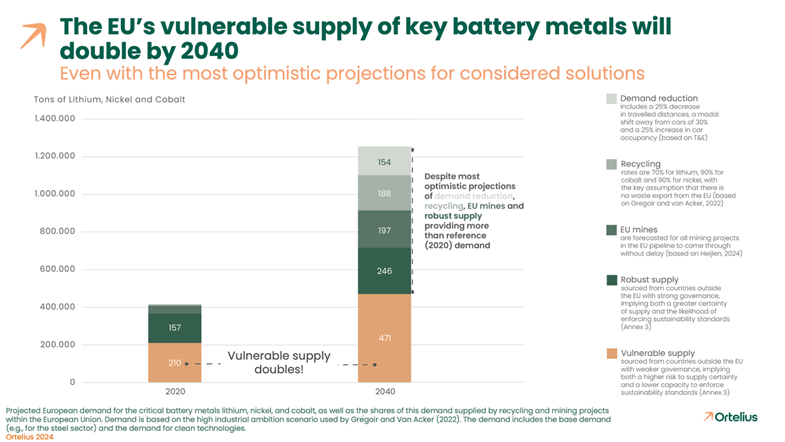
In practice, Europe’s leverage is likely to be strongest in processing, refining, and circularity rather than mining. These activities require early investment, long lead times, regulatory certainty, and above all credible demand signals. Paradoxically, slowing electrification does not reduce material risk. It defers the investments needed to manage that risk and may ultimately compress demand into a shorter future window. Flexibility may ease short-term pressure, but it risks reinforcing long-term vulnerability by delaying the development of resilient and circular material supply chains.
Implications for Europe’s car industry
The automotive value chain illustrates why this matters. Electrification shifts value away from mechanical engineering towards batteries, materials, power electronics, and software. Europe’s historical strength has been its ability to coordinate complex, integrated industrial ecosystems, rather than simply assemble vehicles. If these ecosystems take shape elsewhere, Europe risks losing its position in the critical raw materials value chain altogether.
Belgium illustrates how countries without domestic mining capacity can still be strategically relevant in a materials constrained transition. Today, Belgium contributes to Europe’s EV ecosystem through logistics, chemicals, and battery recycling. These activities position it as an important node in processing and circular supply chains. In the evolving EV landscape, Belgium’s role is likely to grow as Europe seeks to secure materials, increase recycling rates, and reduce external dependence. Its significance lies less in scale than in continuity and integration within the broader European industrial system.
The trade-off ahead
The EU’s decision to introduce flexibility into the 2035 framework reflects genuine economic and political constraints. Ignoring these constraints would not necessarily have strengthened Europe’s industrial position. However, flexibility is not neutral. It reshapes expectations, influences capital allocation, and affects the timing of investments that determine whether Europe can anchor the next generation of automotive value chains.
Electrification is inevitable. Critical raw materials are the binding constraint. The central question is no longer whether Europe will electrify, but whether it will secure the industrial base that supports that electrification. Doing so requires clarity, speed, and sustained investment in materials processing, recycling, and system integration. Without sustained attention to critical raw materials, Europe risks a slower, less controlled, and ultimately weaker transition, even as global electrification accelerates.
[1]You can download the report here: https://ortelius.be/critical-raw-materials/