

After a two-week break from MacroFriday on my part, there’s certainly no shortage of topics to discuss. The U.S. midterm elections and the Brazilian presidential elections have caused significant market movements, while persistent inflationary pressures and resilient economic data continue to influence expectations regarding monetary policy. So there’s more than enough to cover in the coming weeks. This week, however, we’ll stay focused on the financial markets, where recent volatility has led to a sharp decline in stock valuations across various regions.
Although stock prices have fallen, mainly due to a correction among semiconductor companies, corporate earnings remain exceptionally strong. We are nearing the end of the third-quarter earnings season, with 88% of S&P 500 companies having now reported their results. According to FactSet, as many as 84% of these companies have exceeded (high) earnings expectations, while year-over-year earnings growth is expected to exceed 30%. These are remarkable figures, especially given the current economic and geopolitical uncertainty.
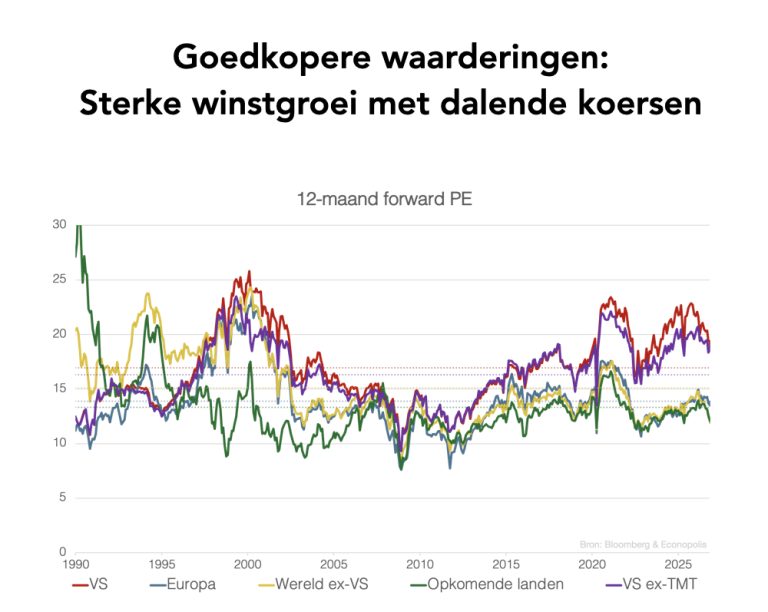
Because earnings expectations have risen more sharply than stock prices, stock valuations have fallen. The price-to-earnings ratio based on expected earnings over the next twelve months (12-month forward P/E) for the S&P 500 has fallen sharply and is now below both the five-year and ten-year averages. As the chart shows, however, U.S. stocks are still trading above a large portion of their long-term historical valuation levels. In the current market environment, earnings expectations remain strong, but investors are increasingly reluctant to pay high valuation multiples for future growth. As a result, investors are increasingly questioning whether the massive capital investments required to build out AI infrastructure will ultimately translate into sufficiently attractive returns.
This chart of global stock valuations highlights several interesting trends. First, the valuation gap between U.S. stocks and the rest of the world remains significant. European stocks, emerging markets, and global stocks excluding the U.S. are still trading at a substantial discount, with valuations in various regions even approaching the lower end of their post-pandemic range once again. Investors are therefore willing to pay a premium for the stronger earnings growth of U.S. stocks. Second, the valuations of U.S. companies excluding technology, media, and telecommunications (TMT) are now above those of the broader U.S. stock market. This demonstrates that these higher valuations are not exclusively a technology phenomenon. This brings us to a third, and perhaps the most striking observation: valuations have fallen despite the fact that corporate profit margins remain close to historically high levels. The markets appear to be increasingly concerned that we are approaching a peak in profitability. Although companies continue to post strong results, investors are wondering to what extent these high margins are sustainable. The main risk, therefore, is that current strong earnings expectations may prove to be overly optimistic. If profit margins normalize or future earnings expectations are revised downward, stocks that seem cheaper today could quickly become expensive again. Although current earnings growth remains high, investor sentiment has deteriorated rapidly, putting pressure on stock valuations. If corporate earnings remain resilient, lower valuations could improve the potential long-term return on stocks.
