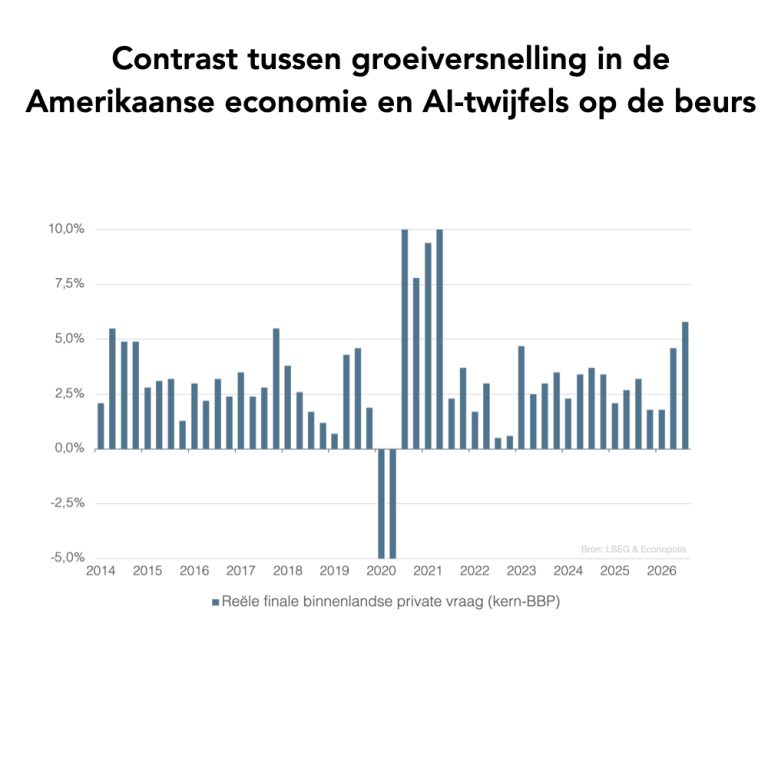

While AI-doubts the financial markets in their grip hold, gives the wave of investment the U.S. economy a powerful boost.
The third-quarter GDP figures released this week underscore the remarkable resilience of underlying domestic demand in the U.S. economy. Real final domestic private demand—a key indicator of the private sector’s economic momentum, also known as “core GDP”—accelerated to an annualized rate of 5.8% in the third quarter. Both surprisingly resilient household consumption and business investment are driving this growth. Private domestic demand is thus making its strongest contribution to economic growth in recent years. The AI investment cycle is increasingly providing a powerful macroeconomic tailwind.
Meanwhile, real U.S. GDP growth in the third quarter came in at 4.3% on an annualized basis, well above the 3.5% that economists had expected. Nevertheless, there is a significant difference between real GDP growth and the measure of underlying domestic demand described above. While household consumption and business investment made strong contributions, net exports dragged down economic growth by 3.2%. However, the sharp increase in imports is at least partly attributable to the expansion of this AI infrastructure, which requires large quantities of chips and technological equipment from abroad.
The strong economic momentum stands in stark contrast to the recent turbulence in AI-related stocks. Despite strong earnings growth so far and the major hyperscalers’ plans for further investment, investor sentiment has deteriorated sharply. The Democratic “blue wave” in the U.S. midterm elections has fueled concerns about stricter regulations surrounding the development of data centers. At the same time, the turmoil surrounding Nvidia—a key player in the AI investment cycle—has further intensified the unrest in the financial markets. Investors are increasingly questioning the sustainability of this unprecedented level of investment spending and the timeframe within which it will yield a financial return. For now, however, economic data points more toward a robust investment cycle than an impending slowdown in growth.