
Pricing power is often a strength of companies; it should never be taken for granted, whether as an investor or a manager. During a period of high inflation following the COVID-19 pandemic (2021–2026), consumers are clearly noticing that many products have become more expensive. Behind the scenes, costs have also risen for many companies, forcing them, in turn, to charge consumers or customers higher prices or to reduce the quantity supplied.
Today, we’ll focus more on price increases using a concrete example: has that price-to-(perceived) value ratio remained stable, or has that price factor risen too quickly? A balanced business model often relies on both volume and price increases, but in which example has that balance shifted entirely toward price increases in order to boost revenue and the corresponding margins even further? What risks does that pose for investors if those price dynamics are disrupted?
First and foremost, pricing power doesn’t just come out of nowhere; it can result from several factors: a lack of alternatives for customers or competitors due, for example, to high barriers to entry (capital requirements, regulation, know-how) that make it difficult to become a competitor. In addition, switching costs or brand recognition can also give some companies pricing power. The stock market is home to countless companies that enjoy multiple advantages.
How Price Increases Can Go Wrong: Fair Isaac
One company that is less well-known to the end consumer is Fair Isaac (FICO): it is an American company that specializes, among other things, in providing credit scores to credit bureaus for loans (mortgages, credit cards, personal loans). To put it simply: every time a consumer submits an application to their bank, an entity such as Fannie Mae (a mortgage purchaser that subsequently repackages these into bonds) looks for an appropriate credit score; to do this, they in turn work with credit bureaus (Experian, Equifax, and TransUnion), each of which has its own data but lacks a universal standard for converting that data into a single, universal number (which requires a scoring model). FICO comes in handy here; until not too long ago, the “repackagers” Fannie Mae and Freddie Mac used only FICO for their calculations. This advantageous position (a monopoly, where the cost of the FICO score as a proportion of the total costs associated with a mortgage was relatively low, while simultaneously serving multiple clients) was also something FICO itself had come to realize since 2018. As a result, the company has begun aggressively raising its prices; whereas in 2018 the cost per (base) score was $0.50–$0.60, by 2025 it will already be $4.95—a price increase of no less than 800%.
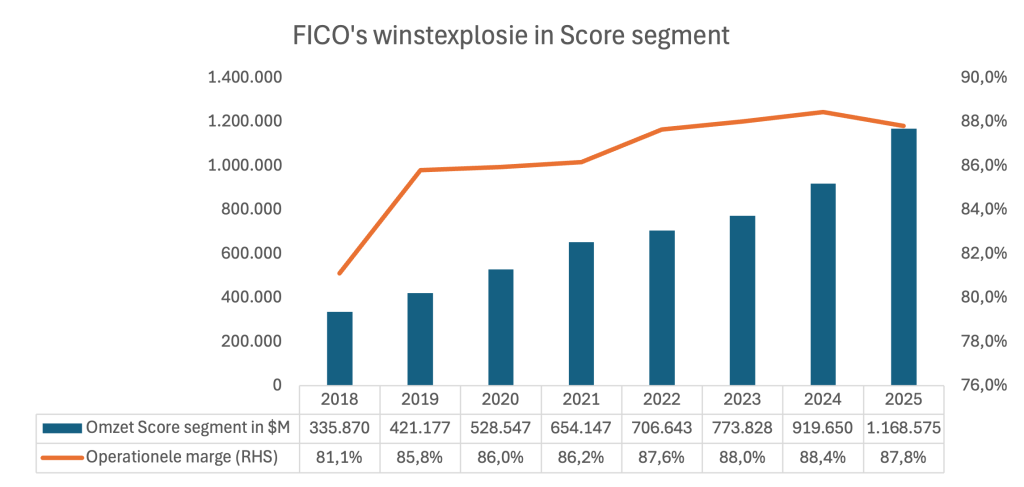
Source: Fair Isaac 10-K 2018–2025; Econopolis
These aggressive price increases led to stable and rapidly growing revenue and even faster-rising margins for FICO, and consequently to rising stock valuations, which in turn drew the attention of regulators and caused frustration among the Fannies, the credit bureaus, and the regulator, who saw the end consumer bearing the brunt of these price hikes. Earlier in 2018, a law had already been passed regarding credit score competition. But it wasn’t until 2022 that competitor VantageScore was approved (fun fact: the company is a joint venture between Experian, Equifax, and TransUnion). While it certainly wasn’t immediately adopted for calculating mortgage loan scores, the pace at which FICO imposed its price increases also brought demand for this alternative increasingly to the forefront.
In addition to the rise of VantageScore, there are also rumors that, in the future, it may be necessary to work with two credit bureaus instead of the mandatory three; this regulatory response could also be very damaging to FICO. All these factors make it very difficult for investors to gain a clear picture of the company’s future market position. The consequences for FICO are significant: not only must the company adapt to the emergence of a competitor—which could weigh on revenue, lead to the loss of potential customers, and result in a slowdown in revenue growth—but this, in turn, could also impact profit margins. These two forces could potentially create negative leverage on profit levels. For investors, these developments are extremely painful; at the time of writing, the stock is down a staggering 67% from its peak in late 2024.
As an active manager, it’s important to spot these pitfalls early on and to constantly put ourselves in the consumer’s shoes to determine whether the price-to-value ratio has become unbalanced. A strong understanding of the business and a feel for the products or services the company offers are therefore essential to making that assessment. A clear understanding of the value chain (gained through interviews with customers and industry experts) and competitors can also provide additional context. The rollout of the personal AI agent Muse can now simplify the time-consuming process of price comparisons for consumers, which may expose the revenue models of companies with overly aggressive pricing strategies.
Disclaimer: This blog post is for informational purposes only and does not constitute investment advice, an offer, or a recommendation. Past performance is not a guarantee of future results.