
Inflation is picking up again in Europe, but so far, the impact on consumers has hardly extended beyond energy prices.
Inflation in the eurozone rose to 3.3% in August, up from 2.9% in July. It comes as no surprise that rising energy prices were a major factor in that increase. The renewed escalation in the Middle East has once again driven up oil prices, while Europe is heading into fall with unusually low gas reserves. As a result, European natural gas prices have risen to their highest level since early 2023. At the same time, this summer’s drought pushed several major European rivers to exceptionally low water levels (as discussed in last week’s MacroFriday), limiting nuclear power generation and putting further upward pressure on electricity prices. Furthermore, goods inflation gradually rose over the summer, from 0.7% in June to 1.2% in August. This may reflect the indirect impact of higher energy and transportation costs on the prices of industrial goods.
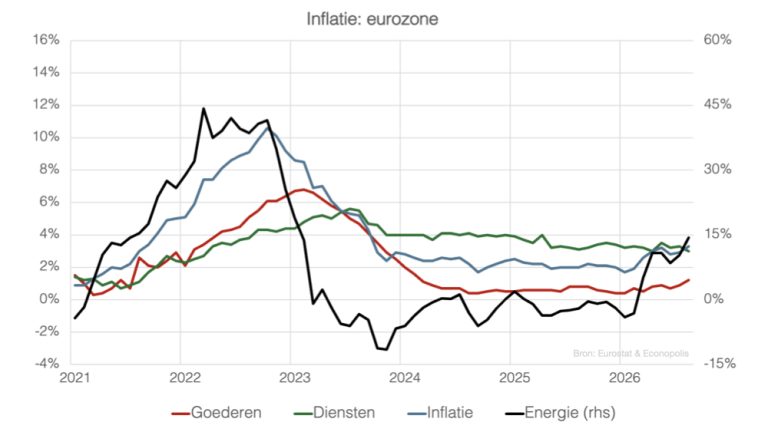
On the other hand, there are currently few signs that the energy shock is taking root in domestic inflation. In fact, services inflation in the eurozone fell from 3.3% to 3.0%, while core inflation declined from 2.5% to 2.4% in August. Although the initial escalation over Iran took place nearly six months ago, the sharply higher energy costs have so far caused few second-round effects. Rising energy prices do, however, remain an upside risk to inflation, especially if higher costs eventually feed through into companies’ pricing and wages. But this is not 2022, when a perfect storm of various factors led to a broad-based wave of inflation. For now, Europe is not facing an inflationary spiral, but inflation does remain above the ECB’s target. The European Central Bank is now poised to raise interest rates again. Services inflation is still too high, although it is declining; however, the current spike in inflation is primarily driven by energy prices, over which the central bank has little control.